How to Build Wealth With $100 a Month: A Beginner’s Step-by-Step Plan
You can build wealth with $100 a month by using the money in the right order: create a small emergency buffer, collect any available employer retirement match, pay down expensive debt, and then invest automatically in a diversified, low-cost fund. One hundred dollars may feel too small to change your financial future, but the real advantage is not the first deposit. It is the habit, the time your money remains invested, and your ability to increase the amount as your income grows.
This guide explains how to build wealth with $100 a month without pretending that every person has the same bills, debt, job benefits, or risk tolerance. It gives you a practical order of operations, real-number examples, a monthly routine, and common mistakes to avoid. The goal is steady progress, not a quick-rich promise.
Can $100 a Month Really Build Wealth?
Yes, but $100 a month works best as a starting point rather than a permanent ceiling. If you contributed $100 at the end of every month and earned a hypothetical average return of 7% a year, the balance would be about $17,300 after 10 years, $52,100 after 20 years, and $122,000 after 30 years. After 40 years, it would be around $262,000. These figures are illustrations, not guarantees. Actual investment returns vary, inflation reduces future purchasing power, and taxes or fees may change your result.
The example still shows why beginning matters. Over 40 years, your own deposits would total $48,000. The remaining growth in the illustration comes from compounding. Investor.gov describes compound interest as earning interest on both your original money and accumulated interest. Time gives each contribution more opportunity to grow, which is why waiting for a “perfect” income can cost more than starting small.
| Time investing | Total contributed | Illustrative value at 7% |
|---|---|---|
| 5 years | $6,000 | About $7,160 |
| 10 years | $12,000 | About $17,300 |
| 20 years | $24,000 | About $52,100 |
| 30 years | $36,000 | About $122,000 |
| 40 years | $48,000 | About $262,000 |
Step 1: Find Your First $100 Without Breaking Your Budget
Start with cash flow rather than an investment app. Review the last two or three months of checking-account and credit-card activity. Separate fixed bills, flexible needs, debt payments, and optional spending. You are looking for a repeatable $100, not a one-time sacrifice that makes the rest of the month unmanageable.
If $100 at once feels difficult, divide it by payday. Someone paid twice a month can move $50 from each paycheck. A weekly schedule is about $23 per week. You can also combine several smaller changes, such as negotiating a phone plan, cancelling one unused subscription, planning two lower-cost meals, or directing part of side-income payments to your goal. Avoid cutting insurance, medicine, necessary food, minimum debt payments, or other essentials merely to meet an arbitrary savings target.
A simple spending framework can help you see where the contribution fits. Our guide to the 50/30/20 budget rule explains how to divide income among needs, wants, and financial goals while adjusting the percentages when housing, debt, or family costs are unusually high.
Step 2: Build a Starter Emergency Fund First
Investing every available dollar while keeping no emergency cash can force you to sell investments or use a high-interest credit card when a car repair, medical bill, or income interruption arrives. For many beginners, the first destination for the $100 should therefore be an accessible savings account.
A practical first milestone is $500 or one insurance deductible, whichever better reflects the emergencies you are likely to face. After reaching that amount, work toward one month of essential expenses and eventually a larger buffer appropriate for your job stability, household size, health needs, and insurance coverage. There is no single emergency-fund number that fits every household.
Keep emergency money separate from daily spending, but make sure it remains easy to access without an investment loss. The Consumer Financial Protection Bureau recommends automatic recurring transfers as a way to make saving consistent. Scheduling the transfer shortly after payday prevents the money from being casually spent while leaving enough flexibility to pause it during a genuine cash shortage.
Step 3: Capture an Employer Match if You Have One
If your employer offers a retirement-plan match, learn its exact formula and eligibility rules. A match can add employer money to your own contribution, so ignoring it may mean leaving compensation unused. For example, if your employer matches your contribution dollar for dollar up to a stated percentage of pay, a $100 employee contribution could become $200 in the account. Actual formulas and vesting rules differ, so check your plan documents or benefits department.
Contribute enough to receive the full available match when your budget and debt situation allow it. In 2026, the IRS says the basic employee elective-deferral limit for many 401(k), 403(b), and governmental 457 plans is $24,500, although your personal affordable amount can be far lower. Contribution limits change, and retirement accounts have tax and withdrawal rules, so verify the current IRS guidance before making decisions.
Step 4: Deal With High-Interest Debt
High-interest credit-card debt can work against wealth building faster than a typical investment is expected to grow. Paying off a card charging 25% interest produces a predictable saving on future interest, while an investment return is uncertain. Continue required minimum payments on every debt, then consider directing your extra $100 toward the highest annual percentage rate.
This does not mean every debt must disappear before you invest. A low-rate fixed loan, an employer match, and your need for emergency savings create different tradeoffs. A balanced approach might send part of the money to a starter emergency fund and part to the highest-rate card. Once that card is paid, roll its old payment plus the $100 into the next debt or investment contribution. That rollover is where progress can accelerate.
Step 5: Choose the Right Account for Your Goal
Your goal determines where the money belongs. Money needed within the next few years generally should not rely on stock-market returns because the market may be down when you need to withdraw it. A savings account can be more appropriate for an emergency fund, upcoming move, vehicle purchase, or short-term tuition bill. Long-term retirement money may fit a workplace plan or an individual retirement account, while other long-term goals may use a taxable brokerage account.
- High-yield savings account: suitable for emergency savings and shorter goals where stability and access matter.
- Workplace retirement plan: especially valuable when an employer match is available.
- Traditional or Roth IRA: may offer tax advantages, subject to eligibility, income, contribution, and withdrawal rules.
- Taxable brokerage account: flexible for long-term investing but without the same retirement-account tax treatment.
For 2026, the combined annual contribution limit across a person’s traditional and Roth IRAs is generally $7,500, or taxable compensation if lower. The general catch-up amount for eligible people age 50 or older raises that figure to $8,600. Income limits can restrict Roth IRA contributions, and traditional IRA deductions may be limited, so use current IRS information or qualified tax help for your circumstances.
Step 6: Invest Simply and Diversify
Beginners often assume wealth requires choosing the next winning stock. In reality, concentrating $100 in one company can expose the entire contribution to one business’s problems. Diversification spreads money across different investments. It cannot prevent all losses, but it reduces dependence on a single company, sector, or security.
One simple approach is a diversified, low-cost index mutual fund or exchange-traded fund that fits your goal and risk tolerance. A broad stock-market fund may hold shares in hundreds or thousands of companies. A target-date retirement fund may combine stocks and bonds and gradually adjust the mix over time, although its fees, underlying holdings, and chosen date still deserve review. Funds carry risk and can lose value.
Pay attention to expense ratios, account charges, trading fees, and advisory fees. Small percentage differences can compound into meaningful dollar differences over decades. The SEC’s Investor.gov fee examples show that higher annual fees can substantially reduce a portfolio’s long-term value. Read the fund prospectus and account fee schedule rather than selecting an investment from a social-media clip.
Step 7: Automate the Entire System
Automation turns a good intention into a recurring action. Schedule the contribution for the day after each paycheck, when cash is normally available. If your chosen investment permits automatic purchases, automate both the transfer and the investment. Money sitting uninvested in a brokerage settlement account may not follow the plan you intended.
Review the system once a month, but avoid reacting to every market move. Confirm that transfers completed, fees remain reasonable, and your emergency balance is adequate. Rebalance only when your allocation has moved meaningfully away from your plan or your goal, timeline, or risk capacity has changed.
A Practical $100 Monthly Wealth Plan
The best order depends on your circumstances, but the following roadmap gives a beginner a sensible starting structure:
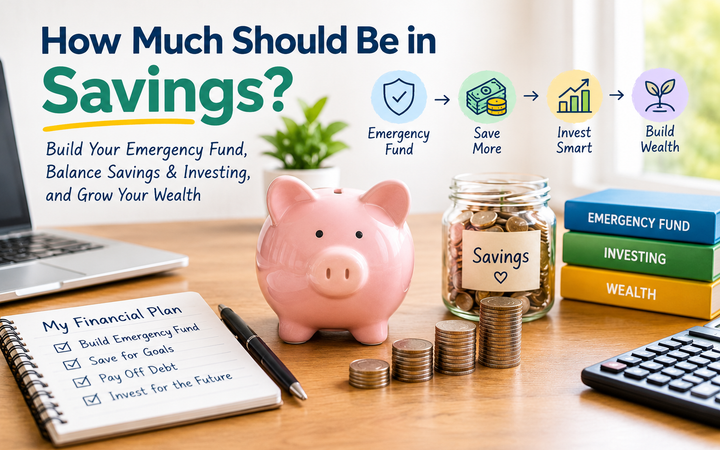
- Months 1 to 5: put $100 per month into an accessible emergency fund to reach $500.
- Month 6 onward: contribute enough to capture an available employer match, if eligible.
- At the same time: direct remaining money toward credit-card or other high-interest debt.
- After expensive debt is controlled: invest the recurring $100 in a diversified, low-cost option suited to your time horizon.
- Every six months: increase the contribution by $10 to $25 if income or expenses permit.
If you already have emergency savings and no costly debt, you may be able to begin at the investing step. If your income is unstable, strengthening cash reserves may deserve more time. This sequence is a decision framework, not a universal rule.
How to Grow From $100 to $300 a Month
The first $100 builds the process. Future raises build the scale. Commit a percentage of each raise, bonus, tax refund, paid-off debt payment, or side-income increase before lifestyle spending absorbs it. For example, you could keep half of a $40 monthly raise for current needs and add the other $20 to your automatic contribution.
Increasing the contribution can have a larger effect than chasing higher returns. At the same hypothetical 7% annual return, $300 a month for 30 years grows to roughly $366,000 compared with about $122,000 for $100 a month. You cannot control market returns, but you have more influence over your savings rate, fees, taxes, diversification, and time invested.
Track Progress With Net Worth, Not Daily Market Moves
Measure progress monthly or quarterly using net worth: what you own minus what you owe. Include cash, investments, and other relevant assets, then subtract credit cards, loans, and other liabilities. Our simple net-worth worksheet shows how to calculate the number consistently.
Your net worth may move up and down because markets and property values change. Focus on the trend over longer periods. Also track controllable actions: months contributed, emergency cash added, debt principal reduced, employer match collected, and fees paid. These numbers show whether your plan is functioning even during a temporary market decline.
Common Mistakes to Avoid
- Waiting until you can invest a large amount: a small automated start develops the habit and protects valuable time.
- Investing emergency money: short-term needs should not depend on selling during a market decline.
- Ignoring expensive debt: high interest can erase progress made elsewhere.
- Chasing trends: recent performance and online popularity do not guarantee future returns.
- Concentrating in one stock or asset: a single failure can damage the whole plan.
- Overlooking fees: recurring costs reduce the money left to compound.
- Checking the account every day: frequent attention can encourage emotional buying and selling.
- Never increasing the contribution: treat $100 as the floor and raise it when your finances improve.
Frequently Asked Questions
Is $100 a month enough to start investing?
Yes. Many accounts and funds permit relatively small recurring contributions, although minimums vary. Before investing, consider whether you need emergency savings, have high-interest debt, or can receive an employer match. Starting with $100 is meaningful, but increasing it over time improves the potential outcome.
Where should a beginner put $100 a month?
The first destination may be a savings account, workplace retirement plan, IRA, debt payment, or brokerage account. Choose according to your emergency reserves, interest rates, employer benefits, tax situation, goal timeline, and risk tolerance. A diversified low-cost fund can be simpler than selecting individual stocks for long-term investing.
Should I save or invest the $100?
Save money needed for emergencies or near-term goals where protecting principal and access matter. Consider investing money intended for longer-term goals when you can tolerate market declines. Some people split the contribution until their emergency fund reaches a comfortable level.
Can I lose money?
Yes. Investments can decline, and returns are not guaranteed. Diversification and a long time horizon can help manage risk but cannot eliminate it. Cash accounts also face inflation risk, and protection rules vary by account and institution.
Final Takeaway
To build wealth with $100 a month, focus on sequence and consistency. Protect yourself with starter emergency savings, take advantage of an employer match when available, reduce costly debt, choose the correct account, use diversified low-cost investments for long-term goals, and automate the contribution. Review the plan periodically and raise the amount whenever your cash flow improves.
The first $100 will not create overnight wealth. It can create something more dependable: a repeatable system that turns future income into assets instead of letting every dollar disappear into spending.
Sources
- Consumer Financial Protection Bureau: Emergency fund guide
- Investor.gov: Compound Interest Calculator
- Investor.gov: Understanding investment fees
- IRS: IRA contribution limits
Educational information only. This article does not provide individualized investment, tax, or legal advice. Consider consulting an appropriate qualified professional before making major financial decisions.