How Much Should Be in Savings? A Smart Beginner’s Guide
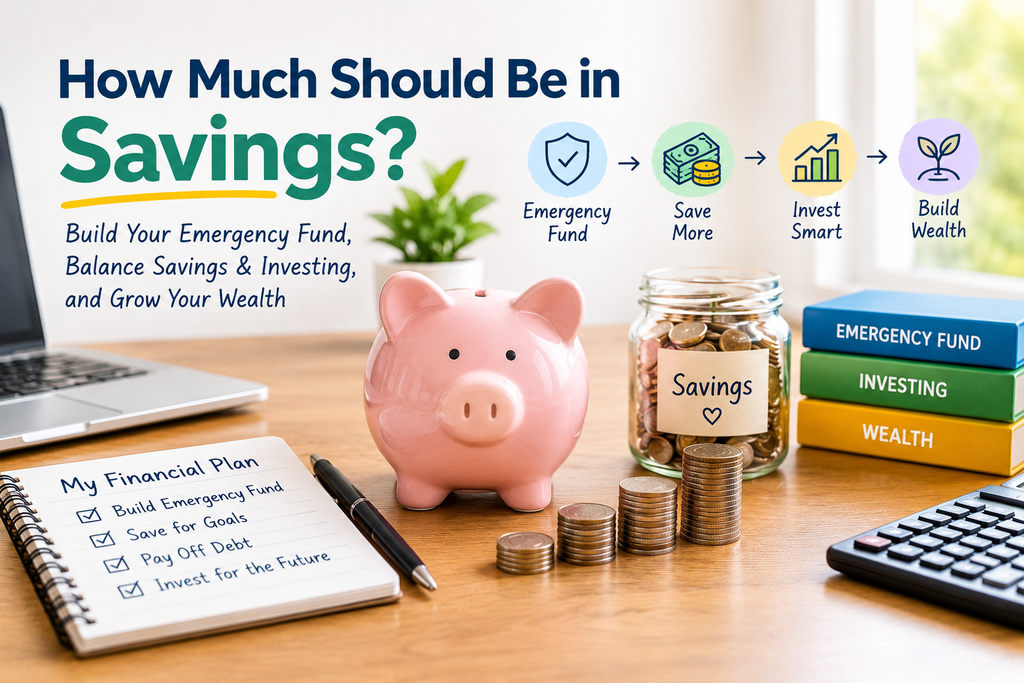
Wondering how much should be in savings? There is no single dollar amount that works for everyone. Your ideal savings target depends on your essential monthly expenses, income stability, debt, family responsibilities, and financial goals.
A practical approach is to build accessible savings for emergencies first. Once your emergency cushion is strong enough and high-interest debt is under control, money you do not need in the near future can potentially be used for long-term investing.
The goal is not to keep every dollar in a savings account. The goal is to give each dollar a purpose: protection, short-term needs, or long-term growth.
How Much Should Be in Savings? Quick Answer
For many people, a useful planning range is three to six months of essential expenses for an emergency fund. However, this is not a universal rule.
Someone with stable income and low fixed expenses may need less. Someone with irregular income, dependents, or higher financial responsibilities may want a larger reserve.
Investor.gov notes that some investors keep enough savings to cover emergencies, with some keeping up to six months of income in savings.
| Savings Level | Main Purpose |
|---|---|
| $500–$1,000 | Handle smaller unexpected expenses |
| 1 month of essential expenses | Build an initial financial cushion |
| 3 months of essential expenses | Provide stronger emergency protection |
| 3–6 months of essential expenses | Build a larger emergency reserve |
| Money beyond emergency needs | Consider long-term financial goals and investing |
These are planning levels, not strict rules. Your personal savings target should reflect your own situation.
How Much Should Be in Savings for an Emergency Fund?
If you’re asking how much should be in savings for emergencies, start with your essential monthly expenses.
Your emergency fund is designed to help cover necessary costs when something unexpected happens, such as job loss, a major repair, or another financial emergency.
A simple formula is:
Essential monthly expenses × number of months = emergency fund target
For example, if your essential monthly expenses are $2,500:
- 3 months = $7,500
- 4 months = $10,000
- 6 months = $15,000
This approach is often more useful than choosing an arbitrary savings number because your actual financial needs are tied to your expenses.
Investor.gov also explains that savings can provide accessible money for emergencies, while investments are generally intended for longer-term goals.
Why Your Savings Target Should Be Based on Expenses
Your income tells you how much money comes into your household. Your expenses tell you how much money you need to keep your household running.
For example, imagine two people each earn $60,000 per year.
One person may have $2,000 in essential monthly expenses, while another may need $4,000.
Their income is the same, but their emergency savings needs are very different.
That’s why how much should be in savings is better answered by looking at essential expenses instead of salary alone.
Start by listing your necessary costs:
- Housing
- Utilities
- Groceries
- Transportation
- Insurance
- Healthcare
- Minimum debt payments
- Essential family expenses
Then separate these from optional spending.
Your emergency fund should primarily cover the expenses you cannot easily stop paying.
What Can Change Your Ideal Savings Amount?
There is no perfect savings number for every household.
Your target may need to be higher or lower depending on factors such as:
Income Stability
If you have a stable job and predictable income, your emergency savings needs may differ from someone with irregular income.
Household Income
A household with two reliable income sources may have a different risk profile from a household that depends on one income.
Dependents
Parents or people supporting family members may need a larger financial cushion because unexpected expenses can affect more than one person.
Debt
High-interest debt can make it harder to build wealth because interest charges reduce the money available for saving and investing.
Upcoming Expenses
If you know you have a major expense coming soon, such as a home repair, tuition payment, or vehicle purchase, that money may need to remain accessible rather than being invested.
Should You Save Money or Invest It?
This is where many beginners get confused.
Saving and investing serve different purposes.
Savings are generally for:
- Emergencies
- Near-term expenses
- Short-term financial goals
- Money you need to access quickly
Investing is generally for:
- Long-term wealth building
- Retirement
- Long-term financial goals
- Money you do not expect to need soon
Investor.gov explains that savings can be useful for emergencies and short-term goals, while investing involves more risk but can provide growth potential over longer periods.
So understanding how much should be in savings can help you decide when additional money may have a different purpose.
When Should You Start Investing?
You do not necessarily need to wait until you have a huge savings balance before thinking about investing.
Instead, build your financial foundation in stages.
1. Build an Initial Emergency Cushion
Start with accessible savings that can handle smaller unexpected expenses.
2. Address High-Interest Debt
High-interest credit card debt can work against your wealth-building efforts.
Investor.gov states that paying off high-interest debt can be more beneficial and less risky than trying to earn investment returns while carrying expensive debt.
3. Build a Stronger Emergency Fund
Continue building savings toward a target that makes sense for your income and expenses.
4. Invest for Long-Term Goals
Once your financial foundation is stronger, regular investing can become part of your long-term wealth plan.
Investor.gov recommends combining budgeting, emergency savings, debt management, and long-term investing as part of a broader wealth-building approach.
Don’t Keep Every Dollar in Savings
Having too little savings can leave you vulnerable to unexpected expenses.
But keeping every dollar in cash may not be appropriate for long-term goals either.
Savings provide accessibility and protection. Investments can provide long-term growth potential, but they also carry risk.
For example, suppose you have built a $20,000 emergency fund and your essential expenses are comfortably covered.
You may not need to treat every additional dollar as emergency savings.
Depending on your goals, time horizon, and risk tolerance, some additional money could potentially be directed toward long-term investments.
A simple framework is:
Emergency money → Savings
Near-term money → Appropriate low-risk savings
Long-term money → Investments
The important thing is to match the money with the job it needs to perform.
What If You Have More Savings Than You Need?
If you’ve already reached the emergency savings target that makes sense for your situation, take a second look at your other financial goals.
Ask yourself:
- Do I have high-interest debt?
- Do I have upcoming major expenses?
- Am I saving for retirement?
- Do I have long-term investment goals?
- Is too much of my money sitting in cash without a specific purpose?
If your emergency fund and short-term needs are covered, additional money may have another job.
Investor.gov recommends having a savings and investment plan, addressing high-interest debt, maintaining emergency savings, and investing regularly for long-term goals.
7 Powerful Ways to Build Your Savings Faster
Knowing how much should be in savings is only useful if you have a practical way to reach your target.
1. Automate Your Savings
Set up an automatic transfer from your checking account to your savings account after payday.
The CFPB recommends consistent contributions and notes that automatic recurring transfers can make saving easier to maintain.
2. Track Your Essential Expenses
Review your monthly spending and identify the expenses you actually need to cover.
This makes your emergency-fund target more realistic.
3. Reduce Recurring Expenses
Look at subscriptions, memberships, services, and other recurring costs.
Cutting even a few unnecessary expenses can create additional room for saving.
4. Save Part of Unexpected Money
A tax refund, bonus, gift, or other unexpected payment can provide an opportunity to increase savings.
Investor.gov also recommends considering how windfalls can be used to reduce debt and strengthen savings or investments.
5. Pay Down High-Interest Debt
High-interest debt can consume money that could otherwise go toward savings and investing.
Investor.gov specifically recommends addressing high-interest credit-card debt before focusing heavily on investing.
6. Increase Savings When Income Rises
If your income increases, consider directing part of the increase toward savings instead of immediately increasing your lifestyle expenses.
7. Give Every Dollar a Purpose
Instead of keeping one large savings balance without a plan, separate your financial goals into categories such as:
- Emergency savings
- Short-term goals
- Long-term investments
- Retirement
This can make your overall financial plan easier to manage.
Where Should You Keep Your Emergency Savings?
Emergency money should be accessible when you need it.
Investor.gov notes that savings are generally kept in accessible places such as savings accounts, checking accounts, or certain deposit products.
For U.S. readers, deposit insurance rules may also matter. For readers outside the United States, check the deposit-protection system that applies in your country.
The key principle is simple:
Emergency money should prioritize accessibility and reliability rather than maximum investment growth.
You generally don’t want to put money needed for an immediate emergency into an investment that could lose value when you need to withdraw it.
How Much Should Be in Savings Before Investing?
There is no universal dollar amount that tells everyone when to invest.
Instead, consider whether you have:
- An initial emergency cushion
- A plan for high-interest debt
- An emergency fund appropriate for your circumstances
- Money set aside for known short-term expenses
- A clear long-term financial goal
Once these areas are reasonably covered, you can consider how much money should remain in savings and how much could potentially be invested for longer-term goals.
This is where how much should be in savings becomes more than a simple number.
It becomes a question of what your money needs to do next.
How Much Should You Have Saved by Age 30?
Age-based savings benchmarks can be useful, but they should not be treated as universal rules.
A retirement savings target is also different from an emergency-fund target.
For example, someone could have a large retirement account but relatively little accessible emergency savings. Another person could have significant cash savings because they are preparing for a home purchase or another major expense.
Those situations require different financial decisions.
Instead of focusing only on age, consider:
- Income
- Essential expenses
- Debt
- Emergency savings
- Retirement contributions
- Investment goals
- Upcoming financial needs
Your savings target should support your actual financial situation.
What If You Have Very Little Savings?
Do not let a large target stop you from starting.
If you currently have only $200 saved, your first goal does not have to be $20,000.
You can build gradually:
$200 → $500 → $1,000 → 1 month of expenses → 3 months → your longer-term target
Small, repeatable contributions can make a large target feel more manageable.
The CFPB recommends creating a system for consistent contributions and monitoring your progress as you build an emergency fund.
A Simple Savings-to-Investing Plan
If you want a straightforward framework, use this progression:
Earn → Budget → Save → Build Emergency Fund → Reduce High-Interest Debt → Invest Regularly → Build Long-Term Wealth
Start by understanding your monthly cash flow.
Then build accessible savings.
After that, deal with expensive debt and continue strengthening your emergency fund.
Once your short-term financial foundation is in place, regular investing can help you work toward longer-term goals.
Investor.gov similarly presents saving, debt management, emergency funds, and investing as connected parts of a broader financial plan.
For another practical budgeting resource, read What Can a Budget Help You Do? 9 Powerful Benefits on WealthNivo.
Frequently Asked Questions
How much should be in savings?
There is no universal amount. A practical starting point is to calculate your emergency savings based on essential monthly expenses. Three to six months is commonly used as a planning range, but your personal target may be different.
Is $10,000 enough savings?
It depends on your expenses. If your essential expenses are $2,000 per month, $10,000 represents five months of expenses. If your essential expenses are $5,000 per month, it represents only two months.
Should I keep six months of income in savings?
Not necessarily. Some people keep up to six months of income in savings, according to Investor.gov, but your own target should reflect your expenses, income stability, and financial responsibilities.
Should I save or invest first?
Start by building accessible emergency savings and addressing high-interest debt. Once your financial foundation is stronger, you can consider regular investing for long-term goals.
How much should I have saved by 30?
There is no universal amount. Retirement benchmarks and emergency-fund targets serve different purposes, so focus on your income, expenses, debt, savings, and long-term goals.
When should I stop adding money to savings?
You don’t necessarily need to stop saving. Once your emergency and short-term needs are adequately funded, you may consider directing more of your new money toward appropriate long-term goals.
Is it bad to have too much money in savings?
Not automatically. Extra cash can be useful for upcoming expenses and financial security. However, money intended for long-term goals may have greater growth potential when invested appropriately rather than kept entirely in cash.
How can I start saving if I have very little money?
Start with a small amount you can repeat consistently. Automate the transfer if possible, monitor your progress, and increase the amount when your income improves. Even a small emergency fund can provide useful financial protection.
Final Takeaway
So, how much should be in savings?
There is no single number that works for everyone.
A better approach is to calculate your emergency-fund target from your essential expenses, consider your income stability and responsibilities, manage high-interest debt, and then decide how much additional money should be directed toward long-term investing.
The goal is not simply to have more cash in the bank.
The goal is to have enough money available for protection while putting appropriate long-term money to work toward your financial goals.