High Yield Savings Account vs Roth IRA: 9 Key Differences
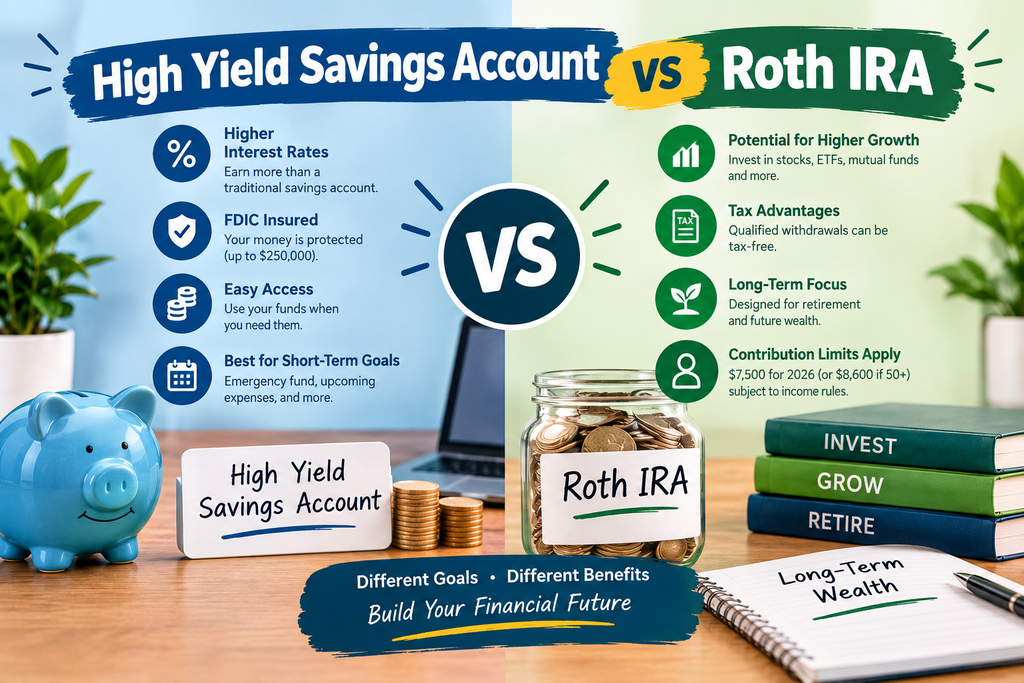
When comparing a high yield savings account vs Roth IRA, the biggest difference is what the account is designed to do. A high-yield savings account is generally used for accessible cash, emergency savings, and shorter-term goals, while a Roth IRA is designed for long-term retirement investing.
These accounts are not really direct substitutes. A high-yield savings account is a deposit account, while a Roth IRA is a tax-advantaged retirement account that can hold investments.
That distinction matters because the account you choose should match the job your money needs to perform.
If you may need the money soon, accessibility and stability can be important. If you are saving for retirement decades from now, the ability to invest and potentially benefit from long-term market growth may matter more.
The good news is that you do not necessarily have to choose one.
Many people can use a high-yield savings account for their emergency fund and short-term goals while using a Roth IRA for long-term retirement investing.
High Yield Savings Account vs Roth IRA: Quick Comparison
| Feature | High-Yield Savings Account | Roth IRA |
|---|---|---|
| Main purpose | Saving and cash management | Retirement investing |
| Account type | Deposit account | Tax-advantaged retirement account |
| Typical holdings | Cash/deposit balance | Investments or other eligible assets |
| Growth | Interest/APY | Depends on investments held |
| Market risk | Generally no stock-market risk to deposit balance | Depends on investments |
| Liquidity | Generally high | More withdrawal rules |
| Annual federal contribution limit | No IRA-style federal contribution limit | Yes |
| 2026 IRA limit | Not applicable | $7,500 for most eligible contributors |
| Tax treatment | Interest generally taxable | Qualified Roth distributions generally tax-free |
| FDIC protection | May apply if it is an eligible deposit at an FDIC-insured bank | Depends on what the Roth IRA holds; securities are not FDIC-insured |
| Best suited for | Emergency funds and near-term goals | Long-term retirement goals |
For 2026, the IRS says total contributions to all of your traditional and Roth IRAs generally cannot exceed $7,500, or $8,600 for people age 50 or older, subject to the taxable-compensation and other applicable rules.
What Is a High-Yield Savings Account?
A high-yield savings account is a savings deposit account that pays interest on your balance.
The main attraction is that your money can earn a competitive annual percentage yield, or APY, while remaining relatively accessible.
Unlike a stock investment, your savings balance does not normally rise and fall because a company’s share price changed.
Instead, the bank pays interest according to the terms of the account.
The APY can change over time, so you should not assume that the rate you see when opening an account will remain unchanged forever.
A high-yield savings account can be useful for money you want to keep available for purposes such as:
- Emergency expenses
- Car repairs
- Medical costs
- A home down payment
- Travel
- Upcoming bills
- Education expenses
- Other short-term goals
The important idea is accessibility.
If you suddenly need $2,000 for an unexpected expense, you generally do not want that money sitting in an investment that could be down significantly when you need it.
What Is a Roth IRA?
A Roth IRA is an individual retirement account that provides specific tax advantages.
Unlike a traditional IRA, Roth IRA contributions generally are not deductible from taxable income.
Instead, qualified Roth IRA distributions can generally be tax-free under the applicable rules. The IRS explains that qualified Roth distributions generally require the five-year rule plus a qualifying condition, such as reaching age 59½, disability, or certain other circumstances.
A Roth IRA is also different from an investment itself.
This is an important point that many beginners miss.
A Roth IRA is the account.
Inside that account, depending on the provider, you may be able to hold investments such as:
- Stocks
- ETFs
- Mutual funds
- Bonds
- Other eligible investments
So when someone says, “My Roth IRA earned 10%,” the more precise question is:
What investments were inside the Roth IRA?
The account itself does not guarantee a particular return.
High Yield Savings Account vs Roth IRA: The Biggest Difference
The biggest difference between a high yield savings account vs Roth IRA is their purpose.
A high-yield savings account is primarily designed to preserve and grow cash modestly while keeping it accessible.
A Roth IRA is designed to hold retirement assets and provide tax advantages under the Roth rules.
Think about it this way:
HYSA: “I may need this money.”
Roth IRA: “I am investing this money for a long-term goal.”
That does not mean you can never withdraw Roth IRA money.
It means the account was designed with retirement investing in mind, and its tax treatment and withdrawal rules are different from those of a regular savings account.
1. Access to Your Money
Liquidity is one of the biggest differences.
A high-yield savings account is generally much easier to access.
Depending on the bank, you may be able to transfer money to another account, withdraw funds, or use other available access methods.
The exact rules, transfer times, fees, and transaction policies vary by financial institution.
A Roth IRA is different.
Roth IRA distributions are governed by tax rules.
Your regular Roth IRA contributions are generally treated differently from investment earnings. The IRS provides specific ordering rules and explains that qualified distributions can be tax-free, while nonqualified distributions may have tax consequences.
This means you should not think of a Roth IRA as simply another savings account.
It is more flexible than some people realize, but it still has rules.
2. High Yield Savings Account vs Roth IRA for Emergency Funds
For an emergency fund, a high-yield savings account is generally a more straightforward fit.
An emergency fund exists for money you may need unexpectedly.
Imagine you lose your job and need money for:
- Rent
- Groceries
- Utilities
- Transportation
- Insurance
- Medical expenses
You want that money to be available.
You also do not want to be forced to sell investments during a market decline simply because an emergency happened at the wrong time.
A high-yield savings account can provide a place to keep that cash while earning interest.
The Federal Deposit Insurance Corporation says eligible deposits at FDIC-insured banks are generally insured up to $250,000 per depositor, per insured bank, per ownership category.
That protection applies to eligible deposit products.
It does not mean every financial product sold by a bank is FDIC-insured.
The FDIC specifically states that stocks, bonds, mutual funds, and other non-deposit investment products are not covered by FDIC deposit insurance.
3. Roth IRA for Long-Term Investing
A Roth IRA is generally more closely connected to long-term investing.
The reason is simple: the account can hold investments that have the potential to grow over many years.
Stocks and diversified funds can produce returns through price appreciation, dividends, or both.
But there is no guaranteed return.
The value of investments can fall.
That is an important distinction between a Roth IRA and a high-yield savings account.
A savings account may provide a stated APY that can change over time.
A Roth IRA’s investment performance depends on what you own.
For example, if your Roth IRA holds a stock fund and the stock market falls, the value of your Roth IRA can fall too.
That risk is part of investing.
4. Growth Potential
When comparing high yield savings account vs Roth IRA, people often ask:
Which one makes more money?
There is no guaranteed answer.
A high-yield savings account pays interest according to its APY.
A Roth IRA does not have a fixed interest rate if it is invested in stocks, ETFs, mutual funds, or similar assets.
Its performance depends on those investments.
Over long periods, market investments have historically provided opportunities for growth, but past performance does not guarantee future results.
This means you should compare these accounts based on time horizon and purpose, not simply on which number looks higher today.
For example:
Money needed next year
A savings account may be more appropriate because you cannot afford a major market decline right before you need the money.
Money intended for retirement decades away
A Roth IRA with an appropriate investment strategy may provide more opportunity for long-term growth, while also exposing you to investment risk.
The time horizon changes the decision.
5. Taxes Work Differently
Taxes are another major difference.
High-Yield Savings Account Taxes
The interest earned in a taxable savings account is generally taxable income.
For example, if your savings account generates interest during the year, that interest may need to be reported on your tax return.
The exact reporting requirements depend on your circumstances.
Roth IRA Taxes
Roth IRA contributions are made with after-tax dollars.
The IRS states that Roth IRA contributions are not deductible, but qualified distributions can generally be tax-free.
That can be valuable for long-term retirement planning.
Suppose you contribute money to a Roth IRA and invest it for decades.
If the investment grows substantially, qualified distributions can potentially be withdrawn without federal income tax on the qualified distribution.
But that does not mean every withdrawal from a Roth IRA is automatically tax-free.
Nonqualified distributions can have different tax treatment, particularly when investment earnings are involved.
6. 2026 Roth IRA Contribution Limit
A high-yield savings account does not have an IRA-style annual federal contribution limit.
A Roth IRA does.
For 2026, the total contribution limit across your traditional and Roth IRAs is generally:
$7,500
For eligible individuals age 50 or older, the limit is:
$8,600
The IRS also states that your total contribution cannot exceed your taxable compensation if that amount is lower.
There are also income-based eligibility rules for direct Roth IRA contributions.
For 2026, the IRS announced Roth IRA income phase-out ranges of:
- $153,000 to $168,000 for single taxpayers and heads of household
- $242,000 to $252,000 for married couples filing jointly
- $0 to $10,000 for married individuals filing separately under the applicable circumstances
These thresholds are based on modified adjusted gross income and filing status.
Because tax rules can change, always check the latest IRS guidance before contributing.
7. Risk and Safety
The word “safe” can mean different things.
A high-yield savings account at an FDIC-insured bank can offer federal deposit insurance for eligible deposits within applicable limits.
That protects against the failure of the insured bank, not against every possible financial loss.
A Roth IRA does not automatically have this type of protection.
If your Roth IRA holds stocks, ETFs, or mutual funds, those investments can lose value.
The FDIC explicitly states that stocks, bonds, and mutual funds are not FDIC-insured.
Therefore:
HYSA risk: primarily interest-rate, inflation, institution, and account-specific risks, with eligible deposits receiving FDIC protection within limits.
Roth IRA investment risk: depends heavily on what you invest in.
The Roth IRA’s tax structure does not protect you from investment losses.
8. Inflation Matters
A high-yield savings account can be useful for protecting short-term money, but inflation is worth considering.
Suppose your savings account earns interest but the prices of goods and services rise faster.
Your account balance may increase while your money’s purchasing power grows more slowly—or even declines.
That is one reason cash savings and long-term investing serve different purposes.
Emergency savings need stability and access.
Retirement assets generally need a long-term growth strategy.
You should not expect a cash account to perform the same job as a diversified investment portfolio.
9. High Yield Savings Account vs Roth IRA for Retirement
For retirement, a Roth IRA is specifically designed for long-term retirement savings.
A high-yield savings account can still hold retirement money, but it may not provide the same long-term investment exposure or Roth tax treatment.
Imagine two people each have $20,000.
Person A keeps the entire amount in a high-yield savings account.
Person B places the money in a Roth IRA and invests it in a diversified portfolio.
The two accounts can behave very differently.
Person A may see a relatively stable cash balance and interest payments.
Person B may see larger ups and downs because the investment portfolio can rise and fall.
Neither outcome is guaranteed.
The important difference is the role of the money.
If Person A needs the money soon, stability may be more important.
If Person B is investing for retirement decades away, market exposure may be more relevant.
High Yield Savings Account vs Roth IRA: Which Is Better for Short-Term Goals?
For short-term goals, a high-yield savings account is generally the more natural fit.
Examples include:
- Emergency fund
- Vacation next year
- Car purchase
- Upcoming tuition
- Home repair
- Moving expenses
- Tax payment
- Large planned purchase
The shorter your timeline, the less time you have to recover from a potential investment decline.
That does not mean every short-term goal must use a savings account.
It means you should consider the consequences if your investment falls shortly before the money is needed.
For money with a short deadline, preserving access and stability can be more important than chasing higher potential returns.
High Yield Savings Account vs Roth IRA: Which Is Better for Retirement?
For retirement investing, a Roth IRA can offer advantages that a regular savings account does not.
The account provides a tax-advantaged structure for qualified retirement distributions.
You can also invest the money inside the account according to the options offered by your provider.
That means your retirement savings can potentially participate in long-term market growth.
But investment growth is not guaranteed.
The Roth IRA’s tax benefits do not eliminate investment risk.
A Roth IRA may therefore be more appropriate for money that you can leave invested for the long term.
Should You Max Out a Roth IRA Before Saving More Cash?
This is one of the most common questions about high yield savings account vs Roth IRA.
There is no single order that works for everyone.
Before deciding, consider:
- Do you have emergency savings?
- Do you have high-interest debt?
- Do you have stable income?
- When will you need the money?
- Are you already receiving an employer retirement match?
- How much investment risk can you tolerate?
- What are your retirement goals?
For example, someone with no emergency savings may need to prioritize accessible cash before aggressively increasing retirement contributions.
Someone with a stable income, adequate emergency savings, and no expensive debt may have more room to prioritize retirement investing.
The answer depends on the entire financial picture.
Can You Have a High-Yield Savings Account and a Roth IRA?
Yes.
In fact, using both can create a simple division of responsibilities.
Your high-yield savings account can hold:
- Emergency savings
- Short-term goals
- Cash reserves
- Near-term expenses
Your Roth IRA can hold:
- Retirement investments
- Long-term investments
- Diversified funds
- Other eligible retirement assets
This approach avoids forcing one account to do two very different jobs.
Think of your money in terms of time:
Money needed soon
Keep it accessible.
Money needed later
Consider appropriate investments.
Money intended for retirement
Consider tax-advantaged retirement accounts such as a Roth IRA when eligible.
How Much Should You Keep in a High-Yield Savings Account?
There is no universal dollar amount.
A common planning approach is to build an emergency fund based on essential monthly expenses.
For example, if your essential expenses are $3,000 per month:
- 3 months = $9,000
- 4 months = $12,000
- 6 months = $18,000
These are planning examples, not universal requirements.
Someone with very stable income may have different needs from someone with irregular income or multiple dependents.
Your emergency savings should reflect your actual circumstances.
For more detailed guidance, see WealthNivo’s guide on How Much Should Be in Savings, which explains how emergency savings can work alongside long-term investing.
How Budgeting Helps You Decide Between HYSA and Roth IRA
The decision becomes easier when you know what your monthly cash flow looks like.
A budget can show:
- Income
- Essential expenses
- Debt payments
- Emergency savings
- Short-term goals
- Retirement contributions
- Investment contributions
- Discretionary spending
For example, suppose you earn $5,000 per month after taxes.
After essential expenses and debt payments, you might have $800 available for financial goals.
Instead of putting all $800 into one account automatically, you could divide it according to your priorities.
Perhaps part goes toward your emergency fund and part toward retirement.
The exact allocation depends on your circumstances.
Our WealthNivo guide What Can a Budget Help You Do? explains how budgeting can create room for both savings and investing.
A Simple Strategy for Using Both Accounts
Here is one way to think about the two accounts.
Step 1: Build an initial cash cushion
Start putting money into an accessible savings account.
Step 2: Build your emergency fund
Work toward a reserve that fits your expenses and job stability.
Step 3: Address expensive debt
High-interest debt can make it difficult to build wealth.
Step 4: Review retirement options
If you qualify for a Roth IRA, consider whether it fits your retirement strategy.
Step 5: Invest the Roth IRA money appropriately
Opening the Roth IRA is not the same as investing the money.
Choose investments based on your goals, time horizon, diversification, and risk tolerance.
Step 6: Continue building cash and investments
As your income grows, consider increasing both savings and retirement contributions.
This creates two different financial layers:
Cash reserve → financial protection
Investments → long-term growth potential
Example: How HYSA and Roth IRA Can Work Together
Imagine a person has $15,000 available after paying their regular expenses.
Instead of asking:
“Should all $15,000 go into a Roth IRA?”
they could ask:
“What jobs does this $15,000 need to perform?”
Suppose they determine:
- $8,000 is needed for emergency savings
- $2,000 is needed for a planned expense
- $5,000 is available for long-term retirement investing
The first $10,000 could potentially remain in an appropriate savings vehicle, while the $5,000 could potentially be considered for a Roth IRA if the person is eligible and has sufficient taxable compensation.
This is only an example.
The right allocation depends on income, expenses, debt, tax situation, investment horizon, and risk tolerance.
But the example illustrates the central concept:
Do not make the account the starting point. Start with the purpose of the money.
Common Mistakes When Comparing HYSA and Roth IRA
Mistake 1: Treating a Roth IRA as an investment
A Roth IRA is an account.
You still need to choose investments inside it.
Mistake 2: Assuming Roth IRA returns are guaranteed
They are not.
Investment performance depends on what you own.
Mistake 3: Keeping all long-term money in cash
Cash can be useful for emergencies, but long-term goals may require a different approach.
Mistake 4: Investing your entire emergency fund
A market decline could make an emergency more difficult to manage.
Mistake 5: Ignoring Roth IRA contribution limits
The IRS limits annual IRA contributions. For 2026, the general limit is $7,500, with an $8,600 catch-up amount for eligible individuals age 50 and older.
Mistake 6: Assuming every savings account is FDIC-insured
Check whether the institution is FDIC-insured and whether the product is an eligible deposit.
Mistake 7: Assuming every Roth withdrawal is tax-free
Qualified Roth distributions can be tax-free, but nonqualified distributions have different rules.
High Yield Savings Account vs Roth IRA: Pros and Cons
High-Yield Savings Account Pros
- Easy access to cash
- Useful for emergency savings
- Generally stable account balance
- Interest earnings
- Eligible deposits may receive FDIC protection
- Useful for short-term goals
High-Yield Savings Account Cons
- Interest rates can change
- Interest is generally taxable
- Long-term growth may be limited compared with investments
- Inflation can reduce purchasing power
- It is not designed specifically for retirement investing
Roth IRA Pros
- Designed for retirement investing
- Potential tax-free qualified distributions
- Can hold investments
- Long investment horizon can support compound growth
- No required minimum distributions for the original owner under current federal rules
- Contributions and earnings receive different tax treatment
Roth IRA Cons
- Annual contribution limits apply
- Income rules can affect direct contribution eligibility
- Investments can lose value
- Withdrawals have tax rules
- The account is primarily intended for retirement
- Investment choices and fees vary by provider
What About a Roth IRA Holding Cash?
This is another point worth understanding.
A Roth IRA can potentially hold cash or cash-like assets depending on the provider.
But putting cash inside a Roth IRA does not automatically turn it into a high-yield savings account.
The account’s tax structure remains a Roth IRA, and the specific product holding the cash determines how it earns and whether any deposit insurance applies.
Likewise, simply calling something a “Roth IRA” does not mean it has the same risk profile as every other Roth IRA.
Two people can have Roth IRAs with completely different investments.
One person might hold diversified stock funds.
Another might hold bonds.
Another might hold cash or other eligible assets.
The account type alone does not tell you the investment risk.
High Yield Savings Account vs Roth IRA for a Young Investor
For younger investors, the long time horizon can make retirement investing particularly relevant.
Someone in their 20s may have several decades before retirement.
That gives long-term investments substantial time to potentially compound.
But young investors should not assume that they should invest every dollar.
They still need cash for:
- Rent
- Transportation
- Emergencies
- Education
- Job transitions
- Other short-term goals
A balanced financial plan can include both.
For example:
HYSA: emergency fund and near-term goals
Roth IRA: retirement investing
Checking account: regular spending
Other investments: additional long-term goals, where appropriate
Each account has a job.
High Yield Savings Account vs Roth IRA for Someone Near Retirement
The comparison can look different for someone approaching retirement.
A person close to retirement may place greater importance on:
- Liquidity
- Capital preservation
- Income needs
- Tax planning
- Diversification
- Withdrawal strategy
That does not automatically mean moving all retirement money into cash.
It means the investment strategy should reflect the shorter time horizon and the need to manage withdrawals.
A high-yield savings account can be useful for cash reserves, while a Roth IRA can continue to hold an appropriately diversified retirement portfolio.
The two accounts can therefore complement one another even later in life.
Official IRS and FDIC Resources
For the most authoritative information, review the IRS’s current guidance on IRA contribution limits.
You can also review the IRS guidance on Traditional and Roth IRAs for current information about Roth contributions and distributions.
For deposit protection, the FDIC’s deposit insurance guidance explains the $250,000 standard coverage limit and which deposit products qualify.
Outbound link used: IRS — IRA Contribution Limits.