How to Save 20K in a Year: 11 Powerful Strategies
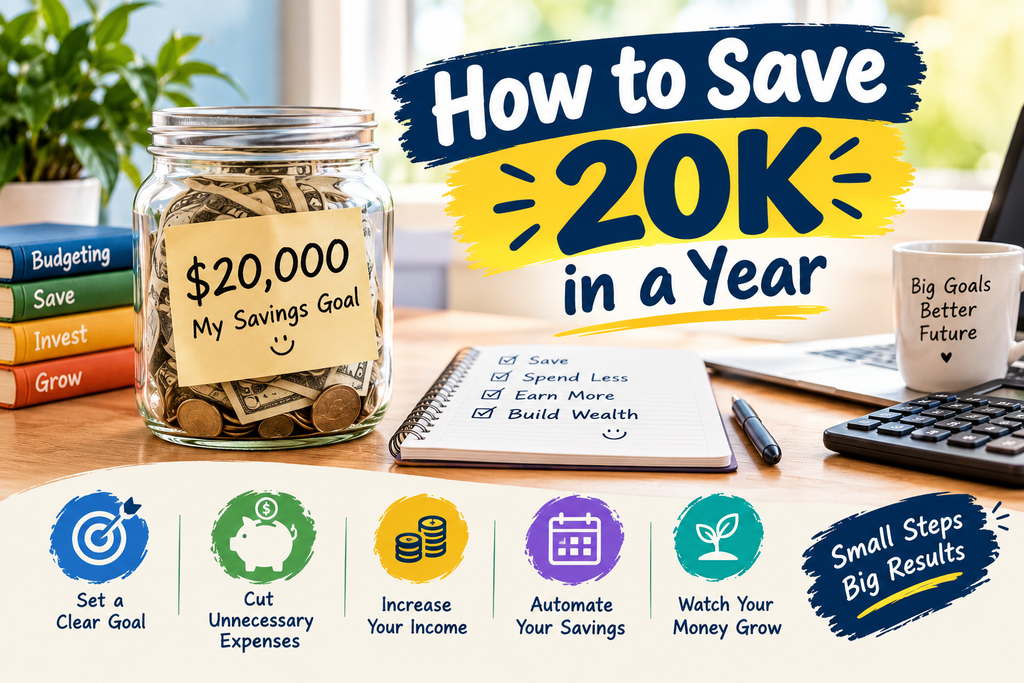
Saving $20,000 in a year is a big financial goal, but it becomes much easier to understand when you break it into smaller targets. To save $20,000 in 12 months, you need to put aside about $1,666.67 per month, $384.62 per week, or about $54.79 per day.
That does not mean you have to cut every enjoyable expense from your life.
The more practical approach is to combine several strategies: control spending, automate savings, reduce large recurring costs, increase income where possible, and give every extra dollar a specific job.
Your income matters, but your cash flow matters just as much.
Someone earning a high salary can struggle to save if most of their income disappears into housing, cars, dining, subscriptions, and lifestyle spending. Meanwhile, someone with a more modest income may make strong progress by keeping fixed costs manageable and consistently saving a defined percentage of each paycheck.
This guide explains how to save 20K in a year with a realistic system you can adjust to your own income and expenses.
How Much Do You Need to Save to Reach $20K?
Before changing your budget, know exactly what the target requires.
Here is the basic breakdown:
| Time Period | Savings Needed |
|---|---|
| 1 year | $20,000 |
| 12 months | $1,666.67/month |
| 52 weeks | $384.62/week |
| 26 biweekly paychecks | $769.23/paycheck |
| 24 twice-monthly paychecks | $833.33/paycheck |
| 365 days | About $54.79/day |
These numbers assume you are starting from $0 and want to accumulate $20,000 through savings contributions alone.
Your personal target could be lower if you already have money saved.
For example, if you already have $5,000 and want to reach $20,000, you only need another $15,000.
That changes the monthly target to $1,250 per month.
This is why the first step should always be calculating your starting point.
1. Start With a $20K Savings Plan
The first step in learning how to save 20K in a year is to turn the goal into a written plan.
A vague goal such as “I want to save more money” is difficult to measure.
A specific goal gives you something you can track.
Write down:
Starting balance: $____
Target: $20,000
Current savings: $____
Remaining amount: $____
Months remaining: ____
Monthly target: $____
If you start with $2,000 and want to reach $20,000, you have $18,000 left to save.
Over 12 months:
$18,000 ÷ 12 = $1,500 per month
That is a much clearer goal than simply saying you want to save more.
Northwoods Credit Union similarly recommends starting with a clear savings goal and breaking larger objectives into manageable milestones.
2. Automate Your Savings
One of the easiest ways to make a large savings goal more consistent is to automate it.
Instead of waiting until the end of the month to see what is left, move money into savings shortly after you receive your paycheck.
For example, if your target is $1,666.67 per month, you could schedule automatic transfers that add up to that amount.
If you are paid twice a month, one simple target would be about:
$833.33 per paycheck
If you are paid every two weeks:
About $769.23 per paycheck
The exact amount should match your actual pay schedule.
The Consumer Financial Protection Bureau recommends automatic saving through recurring transfers from checking to savings as one way to make savings more consistent. It also notes that you should monitor your checking balance so automatic transfers do not create overdrafts.
Automation matters because it removes one decision from your monthly routine.
You do not have to repeatedly ask yourself whether you should save.
The system does the transfer for you.
3. Create a Separate Savings Account
Consider keeping your $20,000 goal separate from your everyday spending account.
Why?
Because money that sits in your checking account can feel available to spend.
A separate savings account creates a psychological boundary.
You can label it something like:
$20K Goal
or
Future Wealth Fund
or
House Down Payment
A high-yield savings account may also be worth considering for money that needs to remain accessible while earning interest.
If you use an FDIC-insured bank, eligible deposit accounts are generally insured up to $250,000 per depositor, per insured bank, per ownership category.
Remember that FDIC insurance applies to eligible deposit products, not investments such as stocks, bonds, or mutual funds.
4. Find Your Biggest Expenses First
If you want to save $20,000 in one year, cutting tiny expenses alone may not be enough.
A $3 coffee is easy to notice.
But your housing, transportation, insurance, debt payments, and recurring bills can have a much larger impact on your cash flow.
Start by reviewing your last one or two months of spending.
Separate expenses into:
Fixed expenses
These might include:
- Rent or mortgage
- Car payment
- Insurance
- Minimum debt payments
- Internet
- Phone service
Variable expenses
These can include:
- Groceries
- Restaurants
- Gas
- Entertainment
- Shopping
- Travel
Recurring discretionary expenses
These might include:
- Streaming services
- Apps
- Gym memberships
- Subscription boxes
- Premium memberships
Look for the categories that can realistically change.
You do not have to eliminate everything.
The goal is to create enough monthly cash flow to make your $20,000 target possible.
5. Use the 24-Hour Rule for Unplanned Purchases
Impulse purchases can quietly interfere with a major savings goal.
One simple technique is to wait 24 hours before making a nonessential purchase.
For more expensive items, you could wait even longer.
Ask yourself:
- Do I need it?
- Did I plan for it?
- Can I afford it without reducing my savings contribution?
- Will I still want it next week?
- Is there a less expensive alternative?
The point is not to avoid spending money forever.
It is to stop automatic spending from controlling your financial plan.
Investor.gov also highlights simple spending-awareness techniques, including delaying impulse purchases and redirecting small amounts toward saving and investing.
6. Cut Recurring Expenses
Recurring charges are especially useful to review because one decision can create savings month after month.
Suppose you cancel or reduce several services and save:
- $25 per month on subscriptions
- $50 on phone or internet
- $40 on insurance
- $35 on other recurring expenses
That creates:
$150 per month
Over 12 months:
$1,800
That is almost 10% of a $20,000 goal.
You do not need to cancel every subscription.
Instead, review your statements and identify services you rarely use.
Financial Footwork’s 2026 savings guide also emphasizes reviewing recurring expenses and subscriptions as part of a broader savings strategy.
7. Lower Your Grocery Spending Without Making Life Miserable
Food can be another flexible category.
You do not necessarily need to follow an extreme grocery budget.
Instead, try:
- Planning meals before shopping
- Checking what you already have
- Buying store brands when they make sense
- Comparing unit prices
- Cooking larger batches
- Taking lunch from home
- Reducing food waste
- Limiting unplanned convenience purchases
Suppose you reduce food spending by $150 per month.
That creates:
$1,800 per year
Add that to $1,800 from recurring expenses, and you have already created $3,600 toward the goal.
The important lesson is that multiple moderate changes can be more sustainable than one extreme restriction.
8. Reduce Transportation Costs
Transportation can be one of the largest expenses in a household budget.
Review:
- Car payments
- Insurance
- Fuel
- Parking
- Maintenance
- Ride-sharing
- Public transportation
- Unnecessary trips
If you have two vehicles, for example, evaluate whether both are genuinely necessary.
If you cannot change your vehicle situation, look for smaller opportunities.
Combining errands, reducing unnecessary driving, comparing insurance quotes, and keeping up with preventive maintenance can help control costs.
You should not make a major financial decision simply because you want to hit a savings target, but transportation is worth reviewing because small monthly changes can have a meaningful annual impact.
9. Increase Your Income
There is a limit to how much you can cut.
You can only reduce rent so far.
You still need groceries.
You still need transportation.
And you should still have room for a normal life.
That is why income can be an important part of your $20,000 strategy.
Consider whether you can:
- Ask for additional hours
- Take freelance projects
- Sell unused items
- Offer a service
- Work seasonal shifts
- Tutor
- Deliver services locally
- Monetize an existing skill
- Negotiate compensation when appropriate
Imagine you generate an additional:
$500 per month
That becomes:
$6,000 per year
You would then need to find only another $14,000 through your existing income and spending plan.
This is much more manageable than trying to cut $1,666 from your lifestyle every month.
10. Combine Expense Cuts With Extra Income
One of the strongest approaches to how to save 20K in a year is combining several smaller strategies.
For example:
| Strategy | Monthly Amount | Annual Amount |
|---|---|---|
| Automatic savings from paycheck | $900 | $10,800 |
| Reduced recurring bills | $150 | $1,800 |
| Lower grocery spending | $150 | $1,800 |
| Extra income | $500 | $6,000 |
| Total | $1,700 | $20,400 |
This example exceeds the $20,000 target by $400.
It also demonstrates an important principle:
You do not necessarily need one huge change.
You need enough smaller changes to close the gap.
Your actual numbers may look completely different.
If you can save $1,000 from your regular paycheck but earn another $700 from additional work, your plan can still reach the same destination.
11. Track Your Progress Every Month
A $20,000 goal can feel overwhelming when you look at the entire number.
Instead, track milestones.
For example:
| Month | Target Cumulative Savings |
|---|---|
| 1 | $1,667 |
| 2 | $3,333 |
| 3 | $5,000 |
| 4 | $6,667 |
| 5 | $8,333 |
| 6 | $10,000 |
| 7 | $11,667 |
| 8 | $13,333 |
| 9 | $15,000 |
| 10 | $16,667 |
| 11 | $18,333 |
| 12 | $20,000 |
These are based on an even monthly contribution of about $1,666.67 and do not assume interest.
Your actual balance could be slightly different if your savings account earns interest or if your contributions vary.
The important thing is to know whether you are ahead, on track, or behind.
What If You Miss a Monthly Savings Target?
Do not abandon the plan because one month goes badly.
Suppose your target is $1,666.67 but you only save $1,200.
You are short by:
$466.67
You can distribute that difference across the remaining months.
If there are 11 months left:
$466.67 ÷ 11 ≈ $42.42
Your new monthly target would increase by roughly $42.
That is much easier to handle than thinking:
“I failed, so the whole plan is over.”
A good savings plan should have some flexibility.
Unexpected expenses happen.
Income changes.
Car repairs happen.
Medical bills happen.
The goal is to adjust rather than quit.
How to Save 20K on a Low Income
Saving $20,000 in one year can be particularly difficult on a lower income.
The math does not change.
But the strategy may need to change.
If your monthly take-home income is $3,000, saving $1,666.67 every month would leave only about $1,333 for everything else.
That may not be realistic depending on your housing, food, transportation, debt, family responsibilities, and other essential costs.
In that situation, do not simply force an unrealistic budget.
Instead, consider a combination of:
Lower target
You could save $10,000 this year and $20,000 over a longer period.
Higher income
Look for sustainable ways to increase earnings.
Lower fixed expenses
Housing and transportation can have a major impact.
Longer timeline
A 24-month plan requires only:
$20,000 ÷ 24 = $833.33 per month
That is half the monthly savings requirement of a 12-month plan.
A goal is useful only when it fits your financial reality.
How to Save 20K With an Irregular Income
Freelancers, business owners, commission-based workers, and seasonal employees may have difficulty using the same fixed monthly savings amount.
Instead of saving exactly $1,666.67 every month, you could use a percentage-based system.
For example:
Every time income arrives, immediately transfer a predetermined percentage toward your savings goal.
During strong months, you may save more.
During weaker months, you may save less.
The CFPB notes that automatic savings can be adjusted when your income or circumstances change.
You can also use higher-income months to build a cushion that protects the plan during slower periods.
Use Windfalls Carefully
A windfall can dramatically speed up a $20,000 savings goal.
Potential examples include:
- Tax refund
- Work bonus
- Commission
- Cash gift
- Sale of unused items
- Freelance project
- Overtime income
You do not necessarily need to put 100% of every windfall into savings.
But if your primary goal is reaching $20,000 quickly, directing a meaningful portion toward the goal can reduce pressure on your monthly budget.
For example, if you receive an extra $3,000 and save it, your remaining target becomes:
$17,000
Over the remaining 12 months, that would be about:
$1,416.67 per month
A windfall can therefore reduce the monthly burden considerably.
Should You Keep the $20K in a Savings Account?
Where you keep the money depends on the purpose and timeline.
If the $20,000 is an emergency fund or money you expect to need soon, an accessible savings account can make sense.
A high-yield savings account may provide interest while keeping the funds relatively accessible.
If you use an FDIC-insured bank, eligible deposit accounts are covered up to the applicable FDIC limits.
However, do not confuse saving with investing.
Stocks and other investments can fluctuate in value, and the FDIC does not insure investment losses.
For short-term money, stability and accessibility may be more important than seeking higher potential returns.
When Should You Start Investing?
Once you have enough accessible savings for your needs, you can think about how additional money fits into your long-term plan.
This is where your $20K savings goal can become part of your investing strategy.
For example, perhaps your original goal is:
Build $20,000 in cash reserves.
Once you reach that target, you might redirect future monthly savings toward:
- 401(k)
- Roth IRA
- Brokerage account
- Other long-term investments
The right account depends on your circumstances and goals.
Investor.gov explains that investing involves putting money into assets such as stocks or bonds with the expectation of earning a return over time, while also emphasizing that investments involve risk and can fluctuate in value.
So don’t invest money simply because you feel like you should.
First determine when you will need the money.
Turn Your $20K Goal Into Long-Term Wealth
Saving $20,000 is valuable on its own.
But what happens after you reach the target can be even more important.
Suppose you save $20,000 and then stop contributing.
You have achieved the short-term goal.
But if you continue building your savings and investing appropriate long-term funds, you can move from simply accumulating cash to building wealth.
Compound growth can become increasingly important over long periods.
Investor.gov explains that compound growth occurs when you earn returns on both your original investment and the returns that investment has already generated.
That is why your investing role in this savings strategy matters.
The goal is not simply:
Save $20,000.
It can become:
Save $20,000 → build financial stability → free up cash flow → invest consistently → build long-term wealth.
For more guidance on creating room for saving and investing, see WealthNivo’s guide on What Can a Budget Help You Do?.
A Sample $20K Savings Budget
Let’s create a hypothetical example.
Suppose someone earns enough to dedicate $1,700 per month toward the goal.
Their plan could look like this:
| Source | Monthly Savings |
|---|---|
| Regular paycheck | $1,000 |
| Reduced expenses | $200 |
| Side income | $400 |
| Automatic transfers from other income | $100 |
| Total | $1,700 |
Over 12 months:
$1,700 × 12 = $20,400
That gives the saver a $400 cushion.
The advantage of building a small buffer is that an unexpected month may not immediately knock the plan off track.
If you are targeting exactly $20,000, aiming slightly above the minimum can provide some breathing room.
A 30-Day Challenge to Start Saving $20K
If $20,000 feels too large, start with the next 30 days.
Week 1: Track everything
Write down every expense.
Do not judge your spending yet.
Just collect the information.
Week 2: Find recurring costs
Review subscriptions, memberships, bills, insurance, and other automatic charges.
Week 3: Create your savings transfer
Set up an automatic transfer based on your realistic target.
Week 4: Find one income opportunity
Look for one additional source of income that fits your schedule and skills.
At the end of the month, calculate:
Income − expenses = available cash flow
Then decide how much of that cash flow can consistently go toward the $20,000 goal.
What Not to Do When Saving $20K
Saving aggressively does not mean making every financial decision based on the target.
Avoid these common mistakes.
Do not drain your emergency fund
If an unexpected expense occurs, you may need accessible cash.
Do not ignore high-interest debt
A savings goal can become less useful if expensive debt continues growing.
Do not create an unrealistic budget
If your budget leaves no room for normal life, you may abandon it quickly.
Do not invest money you need soon
Investments can decline in value.
Do not depend entirely on extreme frugality
Increasing income can sometimes be more effective than cutting another small expense.
Do not compare your savings goal with someone else’s
Your income, expenses, family situation, debt, and goals are different.
Internal Links for WealthNivo
For your WealthNivo article, I recommend these 3 internal links:
- How Much Should Be in Savings — useful when discussing emergency savings and cash reserves.
How Much Should Be in Savings - What Can a Budget Help You Do? — useful in the budgeting and expense-cutting sections.
What Can a Budget Help You Do? - Personal Finance Tips for Beginners — useful in the conclusion for readers who want a broader money-management strategy.
Personal Finance Tips for Beginners
These are naturally relevant rather than adding internal links just for the sake of SEO.
One Authoritative Outbound Link
For readers who want guidance on building an emergency fund and automating savings, link to the Consumer Financial Protection Bureau’s emergency-fund guide:
Consumer Financial Protection Bureau — Building an Emergency Fund
The CFPB specifically discusses automatic transfers and splitting direct deposits as ways to make saving more consistent.