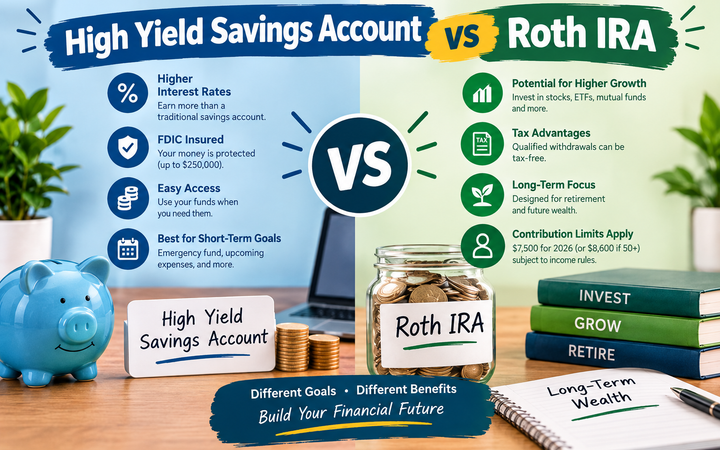
Custodial IRA Account: A Smart Guide to Investing for Kids
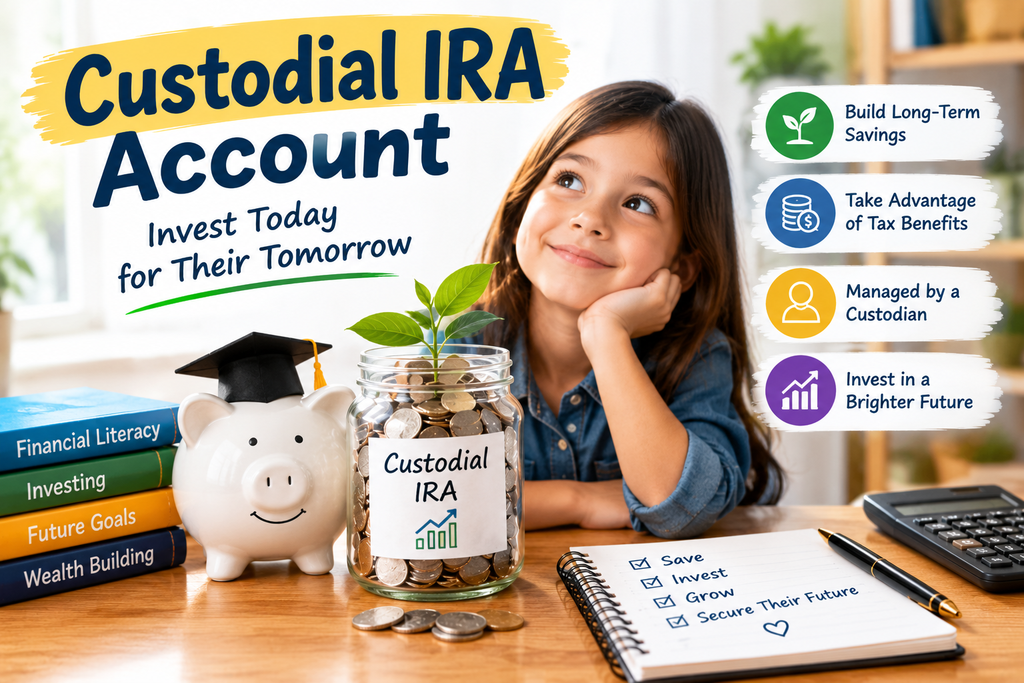
A custodial IRA account allows an adult to manage an IRA for a minor who meets the requirements to contribute. For many families, the most interesting version is a custodial Roth IRA, because a child with legitimate earned income can start investing while still young and potentially give those investments decades to grow.
The important point is that a child cannot simply receive money from a parent and put it into an IRA without meeting the income rules. For 2026, the IRS says total contributions to traditional and Roth IRAs generally cannot exceed $7,500 or the individual’s taxable compensation for the year, whichever is less.
That makes a custodial IRA different from a regular savings account or a general investment account for children. The account belongs to the child, while an adult acts as custodian until the applicable age of majority under state law.
For families thinking about long-term wealth building, this structure can be useful—but only when the account is set up and funded according to the rules.
What Is a Custodial IRA Account?
A custodial IRA account is an IRA established for a minor and managed by an adult custodian.
The child is the account owner and beneficiary, while the adult handles the account while the child is a minor. Fidelity explains that the minor remains the beneficial owner of a custodial Roth IRA, while the custodian controls contributions, investments and distributions until the required transfer age.
The exact transfer age depends on state law and the financial institution. Charles Schwab notes that the age is typically 18 or 21, although some states can provide for a later age.
This creates an important distinction:
The parent or guardian manages the account, but the money is for the child.
That means parents should not think of a custodial IRA as their own retirement account. The assets are intended for the child, and the account eventually becomes the child’s responsibility.
A custodial IRA can be either:
- A Traditional IRA
- A Roth IRA
For young workers, the Roth version is often discussed because contributions are made with after-tax dollars and qualified withdrawals can generally be tax-free.
How Does a Custodial IRA Account Work?
The process is easier to understand when broken into a few steps.
1. The child earns legitimate income
The child must have earned income or taxable compensation to contribute to an IRA.
This could come from traditional employment, but it does not necessarily have to be a W-2 job. Fidelity gives examples such as babysitting, pet sitting and mowing lawns. Schwab also notes that self-employment income can qualify when it represents compensation for work performed by the child.
The income must be legitimate and properly reported.
2. An adult opens the account
Because the child is a minor, a parent or another eligible adult acts as the custodian.
The custodian manages the account and investment decisions while the child is under the applicable age.
3. Money is contributed
The contribution can come from the child or another person, such as a parent or grandparent.
However, the source of the money does not eliminate the child’s earned-income requirement.
For example, suppose a teenager earns $3,000 from a legitimate summer job. A parent could provide the $3,000 contribution as a gift, while the child keeps the earned money for other purposes. The IRA contribution would still be limited by the child’s eligible compensation and the annual IRA limit.
Schwab gives a similar example: if a child earns $3,000 during the year, the maximum total IRA contribution is generally $3,000, even though the annual IRA limit is higher.
4. The money is invested
An IRA is not itself an investment.
It is an account that can hold investments.
Depending on the provider, the child may eventually have access to investments such as stocks, ETFs, mutual funds and bonds. Schwab says custodial IRAs can offer investment choices including stocks, bonds, mutual funds and ETFs.
The investment itself can gain or lose value.
That is why a custodial IRA should not be presented as a guaranteed wealth-building strategy. Investing involves risk, and market values can fall.
Who Can Open a Custodial IRA for a Child?
A parent or guardian commonly serves as the custodian, although the exact rules and account procedures can vary by financial institution and state.
The child remains the owner of the IRA.
Fidelity explains that the adult custodian manages the account until the child reaches the required age, after which control is transferred to the child.
The practical implication is important for parents:
You are managing the account temporarily, not owning the child’s retirement money.
Parents should understand this before making substantial contributions.
Once the child becomes responsible for the account, they will have control over the assets and investment decisions.
Does a Child Need Earned Income for a Custodial IRA?
Yes.
This is one of the most important rules to understand.
A child generally needs earned income to contribute to an IRA. The contribution cannot simply be based on an allowance, birthday money or a parent’s income.
Qualifying compensation can include employment income and certain self-employment income. Fidelity specifically lists activities such as babysitting, pet sitting and mowing lawns as examples of work that may qualify.
Parents should also keep appropriate records.
If a child is earning money from informal work, keeping a written record of the work, dates, amounts received and other relevant information can help document the income.
Fidelity recommends maintaining an earnings log when appropriate, particularly when the child’s income is not reported on a traditional tax form.
That is a simple habit that can make the account easier to manage responsibly.
How Much Can a Child Contribute to a Custodial IRA in 2026?
For 2026, the IRS IRA contribution limit is $7,500.
But that does not mean every child can contribute $7,500.
The child’s eligible compensation is another limitation.
The general rule is:
Maximum contribution = the lesser of $7,500 or the child’s taxable compensation.
So, if a child earns:
| Child’s earned income | Maximum IRA contribution |
|---|---|
| $500 | $500 |
| $1,500 | $1,500 |
| $3,000 | $3,000 |
| $7,500 | $7,500 |
| $10,000 | $7,500 |
The IRS confirms that the 2026 IRA limit is $7,500, subject to the taxable-compensation limitation.
The limit applies across traditional and Roth IRAs rather than giving someone $7,500 for each type.
For example, a child generally cannot contribute $7,500 to a Roth IRA and another $7,500 to a Traditional IRA in the same year.
Why a Custodial Roth IRA Can Be Interesting for Young Investors
The biggest potential advantage is time.
A teenager may have several decades before retirement. That gives investments more time to potentially grow and compound.
Charles Schwab illustrates this with a hypothetical example: a 15-year-old contributing $2,300 annually and earning an assumed 6% average annual return through age 65 could accumulate more than $707,000, while the example’s later starter would need substantially larger annual contributions to reach a similar ending value. The example is hypothetical and does not guarantee investment performance.
This is an important lesson.
The example does not mean every child will earn 6% or accumulate $707,000.
Markets do not provide a guaranteed annual return.
Instead, it demonstrates the mathematical effect of having more years for contributions and investment returns to compound.
That is why starting early can matter.
Custodial IRA Account vs. Regular Savings Account
A custodial IRA and a savings account have different purposes.
A savings account is generally designed for accessible cash and short-term needs.
A custodial IRA is designed around retirement investing.
That difference matters when deciding where a child’s money should go.
For example, money a teenager expects to use next year for a car, tuition or another major expense may not be appropriate for a long-term retirement investment account.
On the other hand, money specifically intended for retirement may benefit from having many years to remain invested.
A simple way to think about it is:
Short-term goal → appropriate savings vehicle
Education goal → consider education-focused options
Long-term retirement goal → custodial IRA may be relevant if the child qualifies
The right account depends on the goal.
Custodial Roth IRA vs. Traditional IRA
Both types are IRAs, but their tax treatment differs.
Custodial Traditional IRA
A Traditional IRA generally uses contributions that may qualify for a tax deduction depending on the taxpayer’s circumstances.
Investment growth is generally tax-deferred, and withdrawals are generally taxable as ordinary income.
Custodial Roth IRA
Roth IRA contributions are made with after-tax dollars.
Qualified withdrawals can generally be tax-free if the applicable requirements are satisfied.
For a young worker with relatively low taxable income, the Roth structure can be appealing because the tax cost of contributing may be relatively small.
Charles Schwab notes that young workers may owe little or no federal income tax depending on their income, which can make Roth contributions particularly attractive in some situations.
However, tax rules can change, and individual circumstances differ. Families should consider their own situation rather than assuming a Roth IRA is automatically the right choice.
Can Parents Contribute to a Child’s Custodial IRA?
Yes, a parent can provide the money for a child’s eligible IRA contribution.
But the child still needs sufficient earned income.
Consider this example:
A teenager earns $2,500 during the year.
The parent wants to help the teenager save.
The parent can contribute $2,500 to the child’s custodial Roth IRA, assuming all other requirements are satisfied.
The child does not need to deposit the exact dollars they earned.
The key limitation is that total contributions cannot exceed the child’s eligible compensation or the applicable annual IRA limit.
Fidelity and Schwab both explain this point in their current guidance for custodial Roth IRAs.
How Does a Custodial IRA Fit Into an Investing Strategy?
This is where a custodial IRA becomes more than just a retirement account.
It can teach a child how investing works.
Instead of simply giving a teenager money, parents can use the account to introduce basic investing concepts such as:
- Compound growth
- Diversification
- Risk
- Long-term investing
- Market volatility
- Contribution consistency
- Retirement planning
- Tax-advantaged accounts
The goal should not be to turn a teenager into an active trader.
In fact, a long-term retirement account may be a useful place to teach the difference between investing and speculation.
A child can learn that owning an investment does not mean its value rises every day.
Some years may be strong.
Some periods may involve substantial declines.
The lesson is to understand the purpose and time horizon of the money before choosing investments.
What Investments Can Be Held in a Custodial IRA?
The available choices depend on the financial institution and account.
Potential investments can include:
- Stocks
- Exchange-traded funds
- Mutual funds
- Bonds
- Other eligible investments offered by the provider
Schwab says custodial IRAs may offer stocks, bonds, mutual funds and ETFs.
The important point is that the IRA itself does not eliminate investment risk.
If a child invests in stocks, the value can fall.
If a fund holds many companies, diversification can reduce certain company-specific risks, but it cannot eliminate market losses.
Parents should also consider the child’s long investment horizon when discussing asset allocation, rather than selecting investments based only on recent performance.
Custodial IRA Withdrawals: What Parents and Kids Should Know
Roth IRA withdrawals can be misunderstood.
Roth contributions are different from investment earnings.
Fidelity explains that Roth IRA contributions can generally be withdrawn without taxes or penalties, while earnings may be subject to taxes and penalties when withdrawal requirements are not met.
Qualified Roth distributions generally require the applicable age and five-year requirements, although exceptions can apply.
Schwab also notes that qualified tax-free withdrawals generally require the account owner to be at least 59½ and to satisfy the five-year rule, subject to applicable exceptions.
This means a custodial Roth IRA should still be viewed primarily as a long-term retirement account.
The fact that contributions may be accessible does not mean the account should be treated like a checking account.
What Happens When the Child Becomes an Adult?
The custodian’s control does not continue forever.
When the child reaches the applicable age under state law and account rules, control of the account is transferred to the child.
Fidelity says this is typically around age 18 or 21 depending on the state, while Schwab notes that some states can provide a later termination age.
This is something parents should discuss with their children before the transfer happens.
A teenager who has learned about investing, taxes and retirement planning may be better prepared to manage the account responsibly.
A teenager who has never seen an investment statement may suddenly receive control of a meaningful financial asset without much experience.
That is why the educational side of a custodial IRA can be just as valuable as the money itself.
Custodial IRA vs. 529 Plan
These accounts can serve very different purposes.
A 529 plan is generally designed around education savings.
A custodial Roth IRA is primarily a retirement account and requires earned income for contributions.
So the choice should begin with the goal.
If the primary goal is funding eligible education expenses, a 529 may be worth considering.
If the child has earned income and the goal is long-term retirement investing, a custodial Roth IRA may be relevant.
Some families may use more than one account because they are solving different financial problems.
Fidelity’s current comparison of children’s savings options similarly emphasizes starting with the goal—such as college, retirement or general savings—before choosing the account type.
Custodial IRA vs. UGMA/UTMA Account
UGMA and UTMA accounts are another option for investing for children.
However, they are not the same as an IRA.
Fidelity describes UGMA/UTMA accounts as custodial brokerage accounts that can hold investments and generally do not have IRA-style annual contribution limits. Money placed into these accounts is an irrevocable gift to the child.
The primary difference is purpose.
A custodial IRA is retirement-focused and has specific tax rules and contribution requirements.
A UGMA/UTMA account can be more flexible in terms of the purpose of the money, but the assets legally belong to the child.
Parents should compare the tax treatment, control, financial-aid considerations and intended use before selecting an account.
What About Trump Accounts?
Families researching children’s retirement accounts in 2026 may also encounter Trump Accounts.
These are different from custodial Roth IRAs.
Anchor Capital describes Trump Accounts as custodial-style IRA accounts created under Section 530A of the Internal Revenue Code, with contributions beginning July 4, 2026 under the law described in its March 2026 analysis.
Fidelity also describes Trump Accounts as a new type of traditional IRA established for children and says they are intended to provide another way to save and invest for a child’s future.
Because these accounts have their own eligibility, contribution and investment rules, they should not be treated as interchangeable with a custodial Roth IRA.
If you’re comparing children’s investment accounts, start with the goal and then examine the rules that apply to each account.
7 Smart Ways to Use a Custodial IRA Account
1. Start With Legitimate Earned Income
Do not make an IRA contribution until you have established that the child has eligible compensation.
Keep records of income, especially when the work is informal.
2. Consider a Roth IRA for Long-Term Investing
A custodial Roth IRA can provide a tax-advantaged structure for a young worker who qualifies.
The earlier the money is invested, the more time it potentially has to compound.
3. Invest According to the Time Horizon
Retirement money for a child may have a very long time horizon.
That does not remove risk, but it can affect how families think about diversification and investment allocation.
4. Teach the Child What the Account Owns
Don’t simply open the account and forget about it.
Show the child how to read the account statement.
Explain what a stock, ETF or mutual fund represents.
5. Automate Contributions When Possible
If the child earns income regularly, consider a consistent contribution schedule.
Regular investing can be easier to maintain than trying to time the market.
6. Keep the Account’s Purpose Clear
A custodial IRA is primarily a retirement account.
Do not treat it as a general-purpose spending account simply because Roth contributions may have withdrawal flexibility.
7. Prepare for the Transfer of Control
The child will eventually become responsible for the account.
Teach financial basics before that happens.
Common Custodial IRA Mistakes to Avoid
Contributing more than the child earned
This is one of the easiest mistakes to make.
If the child earned $2,000, the family generally cannot contribute $7,500 simply because that is the annual IRA limit.
Treating gifts as earned income
Money received as a gift is not automatically earned compensation.
The contribution rules are tied to the child’s eligible income.
Forgetting documentation
Keep records of work and compensation, particularly for informal jobs.
Assuming investments are guaranteed
A Roth IRA provides tax advantages; it does not guarantee investment returns.
Stocks and funds can lose value.
Ignoring the transfer age
Parents should know when the child is expected to gain control of the account.
Using the account for short-term goals
Retirement money should generally be given a long-term role.
If the child needs money soon for a car, school or another expense, a different savings strategy may be more appropriate.
How a Custodial IRA Supports Long-Term Wealth Building
A custodial IRA can fit into a larger family wealth-building strategy.
For example, parents might separate their goals like this:
Emergency money: accessible savings
Education money: 529 or another appropriate education strategy
General-purpose money: custodial brokerage account where appropriate
Child’s retirement money: custodial IRA if the child qualifies
This prevents every financial goal from being placed into one account.
It also helps children understand that different accounts have different jobs.
That lesson becomes increasingly valuable as they become adults.
For example, a young adult who understands the difference between an emergency fund, retirement account and taxable brokerage account has a stronger foundation for making future financial decisions.
If you’re building that foundation, you can also read WealthNivo’s guide to Personal Finance Tips for Beginners for a broader framework covering budgeting, saving, debt and investing.
A Simple Example of a Child Starting Early
Imagine a 15-year-old earns $2,500 from summer and weekend work.
The child is eligible to contribute up to $2,500 to an IRA for that year, assuming the income qualifies and other IRA rules are satisfied.
The family could contribute the full $2,500 to a custodial Roth IRA.
Now suppose the family does not touch the investment for decades.
The $2,500 contribution could potentially compound for many years.
But there is no guarantee about the final balance.
The actual result would depend on investment performance, fees, additional contributions, taxes, inflation and the specific investments selected.
This is why the most valuable lesson may not be the size of the first contribution.
It is learning how time + consistent investing + appropriate risk management can work together.
How to Get Started With a Custodial IRA Account
Before opening the account, work through this checklist.
Step 1: Confirm the child has eligible earned income
Make sure the income qualifies under IRS rules.
Step 2: Document the income
Keep W-2s, business records, payment records or other appropriate documentation.
Step 3: Choose the IRA type
Compare a custodial Traditional IRA with a custodial Roth IRA.
Step 4: Compare financial institutions
Look at investment choices, fees, account requirements and custodial procedures.
Step 5: Make an appropriate contribution
Remember the lower-of-earned-income-or-annual-limit rule.
Step 6: Select diversified investments
Choose investments based on the account’s long-term purpose, risk tolerance and time horizon.
Step 7: Teach the child
Make the account part of the child’s financial education.
Step 8: Review it periodically
Income, goals and investment circumstances can change.
Internal Links for WealthNivo
Add these 3 internal links naturally in the article:
- “personal finance tips for beginners” → place in the section “How a Custodial IRA Supports Long-Term Wealth Building.”
Personal Finance Tips for Beginners - “how much should be in savings” → place after the paragraph discussing emergency money vs. retirement money.
How Much Should Be in Savings - “how to build wealth with $100 a month” → place in the section about long-term wealth building and consistent investing.
How to Build Wealth With $100 a Month
These are relevant because WealthNivo already covers budgeting, emergency savings and long-term investing, so the links create a logical topic cluster rather than unrelated internal links.
Outbound Link
For the one main dofollow-style external resource, use the official IRS page because it is the primary source for IRA contribution limits:
IRS — Retirement Topics: IRA Contribution Limits
Best placement: Put this link immediately after the paragraph under “How Much Can a Child Contribute to a Custodial IRA in 2026?” where the $7,500 limit is explained.
This gives the article a strong authoritative outbound reference rather than linking to another generic finance blog. The IRS confirms the 2026 $7,500 IRA limit and the taxable-compensation limitation.