Monthly Savings Calculator: 7 Powerful Ways to Reach Your Goals
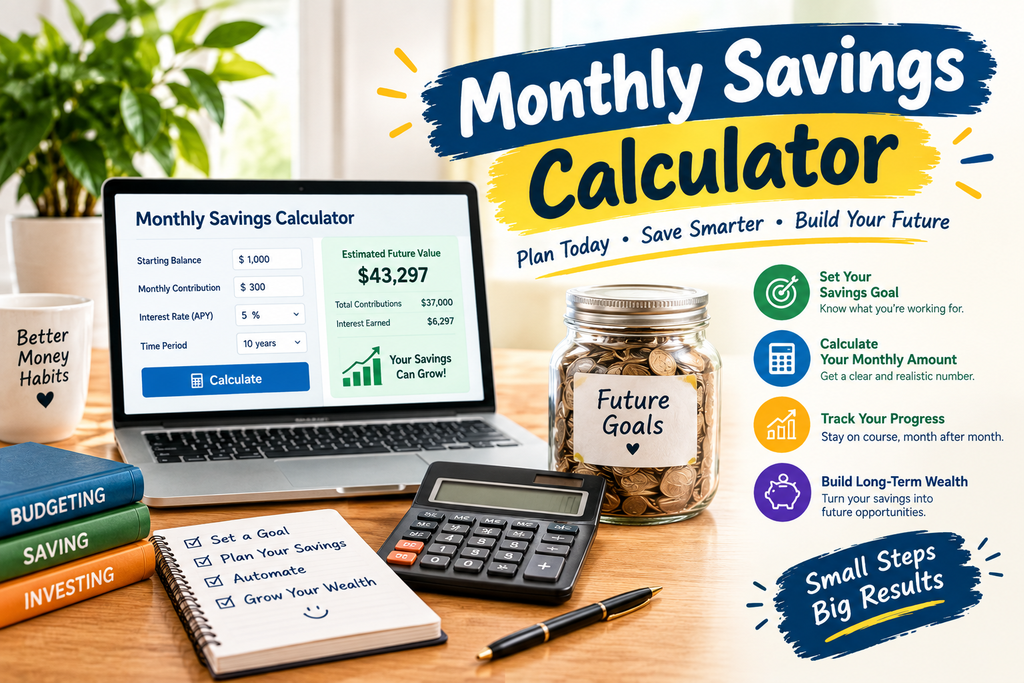
A monthly savings calculator helps you estimate how much you need to save regularly to reach a specific financial goal. By entering your starting balance, monthly contribution, expected interest rate, and time period, you can see how your savings may grow over time.
This can make a large financial goal easier to understand.
Instead of saying, “I want to save $20,000,” you can calculate the monthly amount needed to get there. If you are also earning interest on your savings, the calculation can show how much of the final balance comes from your own contributions and how much comes from interest.
That makes a savings calculator more than a simple math tool.
It can become part of a larger financial plan that connects budgeting, saving, investing, and long-term wealth building.
Investor.gov provides an official Savings Goal Calculator that allows users to enter a savings goal, initial investment, years to grow, estimated interest rate, and compounding frequency.
What Is a Monthly Savings Calculator?
A monthly savings calculator is a financial planning tool that estimates how much your savings could become based on regular contributions and an assumed rate of growth.
Most calculators use several key inputs:
- Current savings
- Monthly contribution
- Savings goal
- Interest rate or APY
- Time period
- Compounding frequency
For example, suppose you currently have $2,000 and want to reach $12,000 in three years.
Without interest, you would need another $10,000.
That means:
$10,000 ÷ 36 months = $277.78 per month
A calculator that includes interest can produce a different required contribution because your existing money and future deposits may earn interest.
This is why the calculation becomes more useful when you include realistic assumptions about your account.
Financer’s savings calculator similarly uses an initial balance, interest rate, savings period, monthly contribution, and compounding interval to estimate a future balance.
How Does a Monthly Savings Calculator Work?
The basic idea is simple.
You tell the calculator where you are starting, how much you plan to contribute, how long you will save, and what rate of growth you expect.
The calculator then estimates the future value.
The most common inputs are:
1. Starting Balance
This is the amount you already have saved.
If you have $3,000 in a savings account, your starting balance is $3,000.
If you are starting from zero, enter $0.
2. Monthly Contribution
This is the amount you plan to add every month.
For example:
$300 per month
or
$750 per month
The larger the contribution, the faster your balance generally grows, assuming other variables stay the same.
3. Interest Rate
This represents the expected rate paid by your savings account.
For deposit accounts, you will often see the rate expressed as APY, or annual percentage yield.
You should use the rate that actually applies to the account you are evaluating rather than assuming today’s rate will remain unchanged forever.
4. Time Period
This tells the calculator how long you plan to save.
You might choose:
- 1 year
- 3 years
- 5 years
- 10 years
- 20 years
The longer the period, the more time regular contributions and compounding have to affect the result.
5. Compounding Frequency
Some calculators allow you to select how frequently interest compounds.
Depending on the account or calculator, this could be monthly, daily, annually, or another interval.
Investor.gov’s compound interest calculator includes monthly contribution, years, estimated annual interest rate, and compounding frequency as inputs.
For a reliable way to estimate how much you need to save each month to reach a financial goal, use the Investor.gov Savings Goal Calculator from the U.S. Securities and Exchange Commission.
Investor.gov Savings Goal Calculator:
Investor.gov Savings Goal Calculator
Monthly Savings Calculator Formula
You do not need to calculate everything manually, but understanding the basic formula can help you understand what the calculator is doing.
For a simplified future-value calculation with regular monthly contributions, a common formula is:
FV = P(1 + r)ⁿ + PMT × [((1 + r)ⁿ − 1) ÷ r]
Where:
- FV = future value
- P = starting balance
- r = periodic interest rate
- n = number of periods
- PMT = regular contribution
The exact formula used by a calculator may vary depending on when contributions occur and how interest compounds.
For example, contributing at the beginning of each month can produce a slightly different result from contributing at the end of each month.
That is why a calculator is useful: it handles the repetitive mathematics while allowing you to focus on the financial decision.
How Much Should You Save Each Month?
There is no universal monthly savings amount.
Your ideal contribution depends on your income, expenses, debt, emergency-fund needs, financial goals, and timeline.
Instead of asking:
“What is the perfect amount to save?”
Ask:
“How much can I consistently save without damaging my essential finances?”
For example, consider three hypothetical savers:
| Saver | Monthly Income | Monthly Savings |
|---|---|---|
| Saver A | $3,000 | $150 |
| Saver B | $5,000 | $500 |
| Saver C | $7,000 | $1,000 |
Each person has a different financial situation.
Saver A may have high housing or family expenses.
Saver C may have lower fixed expenses or a higher savings goal.
The amount matters, but consistency matters too.
The CFPB recommends setting specific savings goals, creating a system for consistent contributions, monitoring progress, and considering automatic transfers to savings.
How to Calculate Your Monthly Savings Goal
You can calculate a basic monthly savings target yourself before using a calculator.
Suppose your goal is:
$15,000
You already have:
$3,000
Your remaining amount is:
$15,000 − $3,000 = $12,000
If you have 24 months:
$12,000 ÷ 24 = $500 per month
So you would need to save approximately $500 per month before considering interest.
A calculator can then show how interest could affect the required contribution.
This approach is helpful because it gives you a starting point even when you do not know the expected rate.
Example: Saving $10,000 Over Two Years
Let’s say you want to build $10,000 in two years and currently have no savings for this particular goal.
Without interest:
$10,000 ÷ 24 = $416.67 per month
So your basic target is about:
$417 per month
Now imagine you put that money into an account that earns interest.
The final result could be higher than $10,000, depending on the actual rate, compounding, fees, taxes, timing of deposits, and whether you consistently make every contribution.
That is an important distinction.
A calculator’s projected result is an estimate, not a guarantee.
Bank5 Connect explicitly notes that calculator results are illustrative and based on hypothetical parameters rather than a guarantee of actual results.
Why Compound Interest Matters
One of the most useful features of a savings calculator is seeing the effect of compound growth.
Compound interest means that you earn interest on your existing balance and, depending on the account and compounding method, on previously earned interest.
Over a short period, the difference may seem small.
Over many years, it can become much more meaningful.
Investor.gov explains compound interest as earning interest on both the original money and interest that has already accumulated.
Consider the difference between:
Saving $300 per month for one year
and
Saving $300 per month for ten years
The second strategy does not simply involve ten times the discipline.
Your contributions have more time to accumulate, and interest can potentially build on earlier interest.
This is one reason long-term saving and investing plans should be evaluated over years rather than weeks.
Savings Calculator vs Compound Interest Calculator
These two tools are related, but they answer different questions.
Savings Goal Calculator
A savings goal calculator typically asks:
“How much should I contribute to reach a specific target?”
For example:
“I want $25,000 in five years. How much should I save each month?”
Investor.gov’s Savings Goal Calculator is designed specifically to calculate the monthly contribution needed to reach a target savings amount.
Compound Interest Calculator
A compound interest calculator typically asks:
“How much could my money grow to?”
For example:
“If I start with $5,000 and add $300 every month for ten years, what could the balance become at an assumed rate?”
Investor.gov offers a separate Compound Interest Calculator for this purpose.
Using both types of calculations can give you a more complete picture.
How to Use a Monthly Savings Calculator for an Emergency Fund
An emergency fund is one of the most practical reasons to use a savings calculator.
The CFPB describes an emergency fund as cash set aside specifically for unexpected expenses such as car repairs, medical bills, home repairs, or loss of income.
Start by estimating your essential monthly expenses.
For example:
- Housing: $1,500
- Utilities: $250
- Groceries: $500
- Transportation: $300
- Insurance: $200
- Minimum debt payments: $250
Total:
$3,000 per month
If your target is three months of essential expenses:
$3,000 × 3 = $9,000
If you already have $2,000:
$9,000 − $2,000 = $7,000
If you want to reach the goal in 14 months:
$7,000 ÷ 14 = $500 per month
A monthly savings calculator can then help you test different contribution amounts and time frames.
For example:
$400 per month → longer timeline
$500 per month → target timeline
$600 per month → faster timeline
That lets you choose a target based on your actual budget.
Use Your Budget Before Choosing a Monthly Savings Amount
A calculator can tell you what you need to save.
Your budget tells you what you can save.
Those are two different questions.
Suppose your calculator says:
Required savings: $800 per month
But after paying essential expenses, debt payments, and normal living costs, you have only $550 available.
That does not mean the calculator is wrong.
It means your goal and current cash flow do not match.
You have several options:
- Extend the deadline.
- Reduce expenses.
- Increase income.
- Lower the target.
- Combine these strategies.
A budget can help identify where your available cash is going and how much may be redirected toward savings.
For a deeper guide, see What Can a Budget Help You Do?.
How Automatic Savings Can Help
Once you know your monthly target, automation can make the plan easier to follow.
Suppose your target is:
$600 per month
You could set up an automatic transfer after payday.
If you are paid twice a month:
$600 ÷ 2 = $300 per paycheck
That gives you a simple system:
Paycheck → automatic savings → remaining money for expenses
The CFPB says automatic transfers can make saving more consistent, while also recommending that people monitor their account balances to avoid overdrafts.
Automation does not magically create money.
It simply makes your savings contribution happen before you have a chance to spend that money elsewhere.
What Happens If Your Income Changes?
Your savings plan should change when your financial circumstances change.
If your income increases, consider increasing your monthly contribution.
For example:
Current savings:
$400/month
After a raise:
$500/month
That additional $100 becomes:
$1,200 per year
If your income decreases, you may temporarily reduce the contribution.
The important thing is to review your plan rather than abandoning it.
A savings calculator is most useful when you treat it as a planning tool that you can revisit.
How a Monthly Savings Calculator Supports Investing
This is where your investing role becomes important.
A savings calculator is not an investment strategy by itself.
Instead, it helps you determine how much money you can consistently set aside.
That consistency can create the cash flow needed for long-term investing.
Think of the process as:
Income → Budget → Savings → Financial Foundation → Investing → Long-Term Wealth
For example, you might first use a calculator to determine how much you need to save for an emergency fund.
After building an appropriate cash reserve, you could use a separate investment calculator to model long-term contributions.
Investor.gov provides both a Savings Goal Calculator and a Compound Interest Calculator as part of its financial planning tools.
This distinction matters because saving and investing have different purposes.
Money needed for a near-term emergency generally needs accessibility and stability.
Money intended for long-term goals may have a different role and could potentially be invested according to your goals and risk tolerance.
Should You Save or Invest Your Money?
The answer depends largely on when you need the money.
Short-term goals
For money needed soon, an appropriate savings account may be more suitable.
Examples include:
- Emergency fund
- Upcoming tuition
- Planned car purchase
- Vacation
- Home repair
- Annual insurance payment
Long-term goals
For money you do not expect to need for many years, investing may be worth considering.
Examples include:
- Retirement
- Long-term wealth building
- Financial independence
- Long-term investment goals
Investments can lose value, however.
That means you should not assume that a stock-market investment will produce a guaranteed result simply because a calculator shows a projected return.
A calculator uses assumptions.
Real markets can behave differently.
How Accurate Is a Monthly Savings Calculator?
A savings calculator is useful, but it cannot predict the future with certainty.
Several factors can change the actual outcome.
Interest rates can change
Many savings accounts have variable rates.
The rate available today may not be the same several months or years from now.
Your contributions may change
You may save more during some months and less during others.
Withdrawals can reduce growth
If you regularly withdraw money, your ending balance may be lower than the original projection.
Fees can matter
Account fees can reduce the amount you ultimately keep.
Taxes may affect interest
Depending on your account and tax situation, interest income may have tax implications.
Financer also warns that savings-calculator results are estimates because rates can change and taxes, inflation, and fees can affect the real outcome.
So use the calculator to plan, not to make a guarantee.
Try Different Scenarios Instead of Using One Number
One of the best ways to use a calculator is to run multiple scenarios.
Suppose your goal is $30,000.
Try:
Scenario A
$400/month
Scenario B
$500/month
Scenario C
$600/month
Scenario D
$750/month
Then compare the required timeline or projected balance.
This gives you a range rather than one rigid target.
You may discover that increasing your contribution by just $100 per month significantly changes your timeline.
That information can help you decide whether to:
- Cut an expense
- Take on extra work
- Extend the goal
- Increase automatic savings
- Adjust another financial priority
How to Reach Your Savings Goal Faster
If your calculator shows that your current plan will take too long, you do not necessarily need to abandon the goal.
Try these strategies.
Reduce One Large Expense
A $100 monthly reduction saves:
$1,200 per year
A $250 monthly reduction saves:
$3,000 per year
Large recurring expenses can therefore have a bigger impact than constantly looking for tiny purchases to eliminate.
Increase Your Monthly Income
If you earn an additional $300 per month and save all of it:
$300 × 12 = $3,600 per year
That could significantly accelerate a savings goal.
The additional income might come from overtime, freelance work, a legitimate side business, or other opportunities that fit your circumstances.
Save Windfalls
A bonus, tax refund, gift, or money from selling unused possessions can help you make a larger one-time contribution.
For example:
$2,000 windfall + $500 monthly savings
can move you toward a goal faster than relying on the $500 monthly contribution alone.
Use a Monthly Savings Calculator for Multiple Goals
You do not need to have only one financial goal.
You might have:
| Goal | Target | Timeline |
|---|---|---|
| Emergency fund | $9,000 | 12 months |
| Vacation | $3,000 | 12 months |
| Car replacement | $12,000 | 3 years |
| Home down payment | $30,000 | 5 years |
| Retirement | Long-term | 20+ years |
Each goal has a different timeline.
That means each goal may require a different savings strategy.
Instead of combining everything into one account mentally, give each goal a specific purpose.
For a broader approach to managing your money, see Personal Finance Tips for Beginners.
Monthly Savings Calculator Example: $20,000 Goal
Let’s say you want to save $20,000.
You currently have:
$5,000
Remaining:
$15,000
You want to reach the target in 24 months.
Without interest:
$15,000 ÷ 24 = $625 per month
So your starting target is:
$625 per month
Now imagine you can only save $500.
Your annual contribution would be:
$500 × 12 = $6,000
Over two years:
$12,000
You would still be short of the $15,000 contribution target by:
$3,000
That gives you a clear problem to solve.
You could:
- Add $125 per month
- Extend the timeline
- Use windfalls
- Reduce expenses
- Increase income
- Combine several approaches
This is exactly where a calculator becomes useful.
It turns a vague goal into a measurable financial decision.
What Is the Best Savings Rate to Use?
If you are calculating savings-account growth, use the actual APY offered by the account you are considering.
Do not simply choose an attractive rate from an old article.
Savings rates change.
A calculator result based on 5% is not useful if your account actually pays 3%.
Similarly, do not assume a high investment return when calculating a long-term portfolio.
For investing, projections should be treated as estimates because actual returns can vary significantly.
The goal of a calculator is to help you understand possible outcomes—not promise them.
How Often Should You Use a Monthly Savings Calculator?
You do not need to calculate your savings every day.
A monthly or quarterly review is usually enough for most personal goals.
Recalculate when:
- Your income changes
- Your savings rate changes
- Your goal changes
- You receive a large windfall
- Your expenses increase
- Interest rates change
- You make a large withdrawal
- Your timeline changes
This keeps your financial plan connected to your actual life.
The CFPB recommends regularly monitoring progress toward savings goals and adjusting the strategy when circumstances change.
A Simple Monthly Savings Plan
If you want to turn the calculator result into a real system, use this five-step process.
Step 1: Choose the goal
Example:
$15,000
Step 2: Enter your current savings
Example:
$3,000
Step 3: Choose your deadline
Example:
24 months
Step 4: Calculate the monthly contribution
Use your calculator to determine the approximate amount.
Step 5: Automate and review
Set up recurring savings and check your progress regularly.
This turns a financial goal into a repeatable habit.
Monthly Savings Calculator: Quick Reference Table
| Goal | Time | Basic Monthly Contribution* |
|---|---|---|
| $5,000 | 12 months | $416.67 |
| $10,000 | 12 months | $833.33 |
| $15,000 | 12 months | $1,250 |
| $20,000 | 12 months | $1,666.67 |
| $10,000 | 24 months | $416.67 |
| $20,000 | 24 months | $833.33 |
| $30,000 | 36 months | $833.33 |
| $50,000 | 60 months | $833.33 |
*These figures assume starting from $0 and do not include interest or investment growth. A calculator using an interest rate may show a different required contribution.
Monthly Savings Calculator vs Manual Calculation
You can always divide your goal by the number of months.
For example:
$24,000 ÷ 24 = $1,000
But this ignores:
- Existing savings
- Interest
- Compounding
- Contribution timing
- Changing rates
A calculator can account for more variables.
That is why it is particularly useful when your goal spans several years.
For a simple one-year goal, manual math may be enough.
For a five-, ten-, or twenty-year goal, a calculator can provide a much clearer illustration of different assumptions.
How Savings Can Become the Foundation for Wealth Building
The most valuable part of a monthly savings plan is not necessarily the calculator itself.
It is the habit the calculator helps you create.
Suppose you begin by saving $300 every month for an emergency fund.
Once that goal is complete, you may redirect some of that same cash flow toward another financial objective.
For example:
Emergency savings → retirement contributions → long-term investing
Your financial priorities can change as your circumstances improve.
This is where saving becomes connected to investing.
You first create financial stability.
Then you create investable cash flow.
Then you can consider how long-term money should be allocated across appropriate investments.
Investor.gov specifically describes its Savings Goal Calculator as a tool for determining how much to save each month for a financial goal and also provides investing and compound-growth tools.