Five Foundations of Personal Finance: 5 Powerful Money Rules
Money problems are often not caused by one bad decision. They usually come from several small issues happening at the same time: spending without a plan, having too little savings, carrying expensive debt, ignoring financial protection, or investing before the basics are ready.
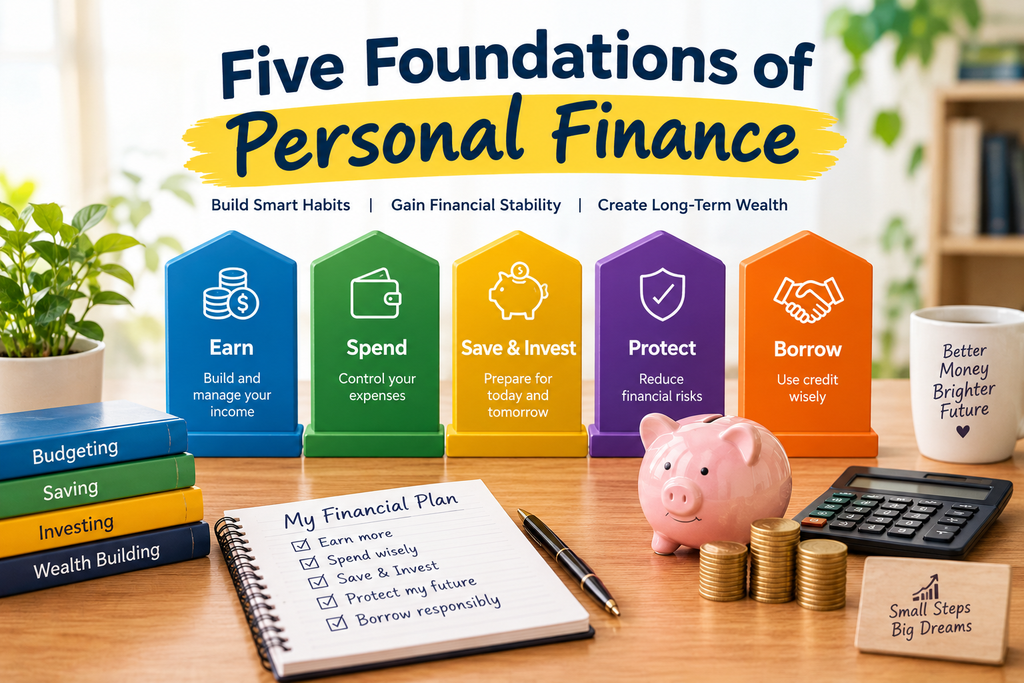
The five foundations of personal finance provide a simple way to organize these areas. A useful framework from MyMoney.gov groups personal money management into Earn, Save & Invest, Protect, Spend, and Borrow. The framework is designed to help people make better day-to-day money decisions while working toward longer-term goals.
The important part is that these foundations are connected. Your income affects your budget. Your budget affects your ability to save. Your savings can protect you from unexpected expenses. Debt affects how much money remains for investing, while protection and insurance can help prevent one major event from damaging years of financial progress.
For someone who wants to build wealth through investing, these foundations create the financial base that makes long-term investing more sustainable.
What Are the Five Foundations of Personal Finance?
The five foundations of personal finance can be organized around five practical areas:
| Foundation | Main Purpose | Connection to Investing |
|---|---|---|
| Earn | Build and manage income | Creates money available for financial goals |
| Spend | Control where money goes | Creates room for saving and investing |
| Save & Invest | Prepare for short- and long-term goals | Builds financial reserves and long-term assets |
| Protect | Reduce financial risks | Helps protect savings and investments |
| Borrow | Use debt carefully | Prevents expensive debt from consuming future cash flow |
MyMoney.gov calls these principles the MyMoney Five and describes them as building blocks for managing and growing money.
Different financial educators may organize the foundations differently. Some frameworks emphasize emergency savings, debt repayment, investing, insurance or financial education as separate pillars. The exact labels can change, but the underlying idea is similar: financial stability comes from managing income, spending, saving, risk and debt together.
1. Earn: Build a Strong Income Foundation
The first of the five foundations of personal finance is understanding and improving your income.
Your income is the fuel for almost every other financial goal. Without enough cash coming in, it becomes difficult to cover basic expenses, build savings, repay debt and invest consistently.
Start by understanding your actual take-home income rather than focusing only on your gross salary.
For example, someone may see a salary figure on a job offer and assume that amount is available for spending. Taxes, retirement contributions, insurance premiums and other deductions can reduce the amount that actually reaches the bank account.
Your budget should therefore be based on the income you can realistically use.
Ways to strengthen your income foundation
You can improve this foundation by:
- Developing valuable career skills
- Negotiating compensation when appropriate
- Looking for higher-paying opportunities
- Building legitimate side income
- Increasing professional qualifications
- Turning useful skills into freelance income
- Avoiding lifestyle inflation when income rises
Increasing income does not automatically create wealth.
If someone earns more but immediately increases their spending by the same amount, their financial position may not improve much.
A stronger approach is to give new income a purpose.
For example, after receiving a raise, you could divide the additional money among:
- Emergency savings
- Debt repayment
- Retirement contributions
- Long-term investments
- A reasonable lifestyle improvement
That creates a connection between earning more and building wealth.
Why income matters for investing
Investing requires money that you can leave invested for an appropriate period.
A person who has no monthly surplus may struggle to make consistent investment contributions. Increasing income can create that surplus.
This does not mean you need a high salary before investing. Even small contributions can become part of a long-term financial system when they are affordable and consistent.
2. Spend: Give Every Dollar a Job
The second foundation is spending.
This is where budgeting becomes important.
A budget is not simply a list of bills. It is a plan for deciding where your money should go before you spend it.
Zell Education’s 2026 personal-finance guide discusses budgeting methods including the 50/30/20 framework and zero-based budgeting, while also connecting budgeting with saving, investing and debt management.
You do not have to use one specific budgeting method.
The best system is the one you can realistically maintain.
Start with four spending categories
A simple beginner budget can separate money into:
Essential expenses
- Housing
- Food
- Utilities
- Transportation
- Insurance
- Healthcare
- Minimum debt payments
Financial goals
- Emergency savings
- Retirement
- Investing
- Planned purchases
Flexible spending
- Dining out
- Entertainment
- Shopping
- Hobbies
- Travel
Debt repayment
- Credit cards
- Personal loans
- Student loans
- Other balances
This makes it easier to see where your money is going.
For a deeper guide on how budgeting can create room for saving and investing, you can internally link this section to your existing WealthNivo article:
What Can a Budget Help You Do? 9 Powerful Benefits
Why spending control matters for investing
Suppose two people earn the same amount.
One spends almost everything each month.
The other controls flexible expenses and consistently has money left over.
The second person has more room to build an emergency fund, repay debt and make long-term investment contributions.
That is why investing does not begin with choosing a stock or fund.
It often begins with creating enough cash flow to invest consistently.
3. Save & Invest: Separate Short-Term Security From Long-Term Growth
The third foundation is where saving and investing come together.
However, saving and investing are not the same thing.
Saving is generally used for money you may need in the near future or for emergencies.
Investing is generally used for longer-term goals where you can accept some level of investment risk in exchange for the possibility of growth.
MyMoney.gov specifically combines saving and investing into one of its five principles and notes that people can start saving for future goals such as a home or retirement even with small amounts.
Build emergency savings first
An emergency fund gives your financial plan a layer of protection.
Unexpected expenses can include:
- Car repairs
- Medical costs
- Home repairs
- Temporary income loss
- Family emergencies
- Unexpected essential bills
There is no universal emergency-fund amount that works for everyone.
A commonly used planning range is several months of essential expenses, with the appropriate amount depending on income stability, household responsibilities, debt and other circumstances.
Your existing WealthNivo savings article can be used as an internal link here:
How Much Should Be in Savings? A Smart Beginner’s Guide
Why emergency savings matters before investing
Imagine you have $5,000 invested and suddenly need $2,000 for an emergency.
If you have no cash reserve, you may have to sell an investment at a bad time.
The investment could be worth less than what you originally paid.
An emergency fund can reduce the chance that short-term financial problems force you to interfere with long-term investments.
That is one reason saving and investing should work together rather than being treated as competing goals.
When Should You Move From Saving to Investing?
There is no single savings balance that automatically means you are ready to invest.
Instead, look at your overall financial situation.
You may want to consider:
- Whether you have some emergency savings
- Whether essential bills are manageable
- Whether high-interest debt is under control
- Whether you have a clear long-term goal
- Whether you understand the risk of the investment
- Whether you can leave the money invested for the appropriate time period
Investor.gov also emphasizes emergency savings, managing high-interest debt and regular investing as important parts of a long-term financial approach.
The key is to avoid investing money that you know you will need for an immediate financial obligation.
4. Protect: Keep One Financial Problem From Becoming a Crisis
The fourth foundation is protection.
Saving and investing can build wealth, but protection helps prevent unexpected events from damaging that progress.
Protection can include appropriate insurance, emergency savings, account security and basic financial planning.
MyMoney.gov includes protection as one of its five core principles and specifically connects it with emergency savings and having appropriate insurance.
Types of financial protection to consider
Depending on your situation, protection may include:
- Health insurance
- Auto insurance
- Home or renters insurance
- Life insurance
- Disability coverage
- Emergency savings
- Secure banking practices
Not everyone needs the same coverage.
Your age, income, dependents, assets, employment and financial responsibilities can all affect the type and amount of protection that makes sense.
Why protection matters to investors
Imagine someone spends years building an investment portfolio.
Then an uninsured event creates a large financial obligation.
They may need to sell investments to cover the expense.
That could interrupt their long-term plan.
Insurance is therefore not simply another bill. Appropriate insurance can be part of a broader strategy for protecting the financial foundation that supports investing.
5. Borrow: Understand the Real Cost of Debt
The fifth foundation is borrowing.
Debt can be useful in some circumstances. Mortgages, student loans, business financing and other forms of credit can help people make major purchases or pursue opportunities.
But borrowing also has a cost.
That cost includes interest, fees and the loss of future cash flow.
MyMoney.gov describes borrowing as a way to finance certain purchases and build credit, while also warning that interest costs money and excessive borrowing can leave people with substantial debt to repay.
Not all debt is identical
A $2,000 credit-card balance at a high interest rate is financially different from a lower-rate loan used to purchase an asset.
That does not automatically make one type of debt good and another bad.
The important questions are:
- What is the interest rate?
- What is the monthly payment?
- How long will repayment take?
- Is the debt necessary?
- Does the purchase support or damage your financial goals?
- How does the payment affect your ability to save and invest?
High-interest debt deserves attention
High-interest consumer debt can make wealth building harder.
If a large part of your monthly income goes toward interest and debt payments, less money remains for emergency savings and long-term investments.
Mostt’s 2026 financial-habits article similarly emphasizes living within your means, building an emergency fund, addressing high-interest debt and prioritizing retirement savings.
How the Five Foundations Work Together
The real value of the five foundations of personal finance appears when you connect them.
Think about the system this way:
Earn → Spend → Save & Invest → Protect → Borrow Wisely
These are not isolated actions.
Your income determines how much money enters your household.
Your spending determines how much remains.
Your savings provide short-term protection.
Your investments provide a potential path toward long-term growth.
Your insurance and emergency planning help protect the system.
Your debt decisions determine how much future income is already committed.
This creates a financial cycle.
If one area is weak, the others may become harder.
For example:
High spending → little savings → emergency → credit-card debt → less money available for investing
Now consider the opposite:
Controlled spending → emergency savings → manageable debt → regular investing → long-term wealth building
The second system is not guaranteed to produce a particular investment result. Markets can rise or fall, and investment returns are never guaranteed.
But the financial structure can make consistent long-term investing more practical.
How to Build an Investing Plan After the Five Foundations
Once the basic financial structure is in place, investing becomes easier to approach logically.
Start with the goal.
Are you investing for:
- Retirement?
- A future home?
- Education?
- Long-term wealth?
- Another goal that is many years away?
The time horizon matters because different goals can require different approaches to risk.
Understand risk
Every investment carries some form of risk.
Stocks can fall.
Bonds can lose value.
Real estate can decline.
Even cash has purchasing-power risks over long periods when inflation reduces what your money can buy.
The goal is not to eliminate every risk.
The goal is to understand which risks you are taking and why.
Understand diversification
Diversification means spreading investments rather than relying on one asset or company.
The idea is straightforward: if your entire portfolio depends on one investment, a major decline in that investment can have a large effect on your overall wealth.
A diversified approach can spread exposure across different investments, although diversification cannot guarantee profits or prevent losses.
Invest according to your timeline
Money needed next month is very different from money intended for retirement decades from now.
This is why the five foundations should come before blindly investing every dollar.
Short-term needs need appropriate liquidity.
Long-term goals may allow more exposure to investments with greater potential volatility.
Five Foundations of Personal Finance and Retirement Planning
Retirement planning is one of the clearest examples of how all five foundations connect.
You need income to contribute.
You need spending control to create room.
You need savings for short-term needs.
You need protection against major financial risks.
You need careful borrowing so debt does not consume your retirement cash flow.
Then investing can help put long-term retirement money to work.
Mostt’s article highlights retirement savings as an area people should not neglect and discusses employer retirement plans, IRAs, contribution increases and diversification as part of its 2026 guidance.
You should not assume that one contribution percentage or investment strategy works for every person.
Your retirement needs depend on factors such as:
- Current age
- Income
- Existing retirement savings
- Desired retirement lifestyle
- Expected retirement age
- Other assets
- Expected future income
- Risk tolerance
The important habit is to start planning and review the plan as your circumstances change.
How Budgeting Connects the Five Foundations
Budgeting is the bridge between the foundations.
Without a budget, it is difficult to know whether you have enough cash flow for your goals.
For example, suppose your monthly take-home income is $4,000.
You may have:
- $2,200 essential expenses
- $500 debt payments
- $400 flexible spending
- $300 emergency savings
- $300 investments
- $300 remaining for other goals
The exact numbers will differ from person to person.
The point is that budgeting makes the money flow visible.
Your existing WealthNivo guide on personal finance can also support this section:
Personal Finance Tips for Beginners: A Simple Guide to Managing Your Money
This internal link fits naturally because readers who are learning the five foundations may also need a broader introduction to personal finance.
A Simple 90-Day Plan to Apply the Five Foundations
You do not need to rebuild your financial life in one weekend.
A 90-day plan can make the process easier.
Days 1–30: Understand Your Money
Start by tracking:
- Take-home income
- Fixed expenses
- Flexible expenses
- Debt balances
- Interest rates
- Current savings
- Investments
- Insurance coverage
The goal is awareness.
You cannot improve a financial system you do not understand.
Days 31–60: Stabilize Your Finances
Now create a realistic budget.
Focus on:
- Cutting unnecessary recurring expenses
- Building emergency savings
- Making every debt payment on time
- Prioritizing expensive debt
- Reviewing insurance needs
- Automating savings
Do not try to eliminate every enjoyable expense.
A financial plan has to be sustainable.
Days 61–90: Start Building Long-Term Wealth
Once your basic financial system is working, focus on long-term goals.
You can:
- Increase your savings rate
- Increase retirement contributions where appropriate
- Learn basic investment concepts
- Review your asset allocation
- Track net worth
- Work on increasing income
- Set specific financial milestones
This is where budgeting and investing begin to work together.
Common Mistakes to Avoid
Trying to invest before understanding your finances
Investing without knowing your cash flow can create unnecessary problems.
First understand what you earn, spend, owe and save.
Keeping no emergency savings
Investing every available dollar may look productive, but short-term emergencies can still happen.
Accessible savings can provide a financial buffer.
Ignoring high-interest debt
Expensive debt can absorb money that could otherwise support savings and investments.
Treating the 50/30/20 rule as a law
Budgeting percentages are guidelines.
Your actual numbers may be different because of housing costs, family responsibilities, income and financial goals.
Chasing investment trends
A popular investment is not automatically suitable for your financial situation.
Understand the risk before investing.
Increasing lifestyle spending with every raise
Higher income can improve your lifestyle, but directing some additional income toward financial goals can also strengthen your future position.
Forgetting financial protection
A financial plan should not focus only on returns.
Protection matters because one major financial event can affect years of savings and investing.
The Five Foundations of Personal Finance: A Practical Checklist
Use this checklist to see where you stand.
Earn
- I know my monthly take-home income.
- I understand my employee benefits.
- I am working on increasing my earning potential.
Spend
- I track my expenses.
- I have a realistic monthly budget.
- I know which expenses are essential.
Save & Invest
- I have emergency savings.
- I save consistently.
- I understand my long-term investing goals.
- I invest according to my risk and time horizon.
Protect
- I have appropriate insurance.
- My emergency savings are accessible.
- I protect my financial accounts.
Borrow
- I know all my debt balances.
- I know my interest rates.
- I have a debt repayment plan.
- I avoid unnecessary high-cost borrowing.
This checklist can also be useful as a starting point for reviewing your finances every few months.
Why the Five Foundations Matter for Wealth Building
The five foundations of personal finance are not a shortcut to becoming wealthy.
They are a framework for making financial decisions more organized.
The biggest benefit is that they connect short-term decisions with long-term goals.
Saving $100 is a short-term action.
Paying down expensive debt is a short-term and medium-term action.
Investing consistently for retirement can be a long-term action.
Protecting your income and assets helps support all three.
Over time, these decisions can reinforce each other.
That is the real investing role of the five foundations.
You are not simply trying to find the next investment that will rise.
You are building a financial system that gives you a better chance of staying invested, handling emergencies and continuing toward long-term goals.
For readers who want an authoritative government-based overview of these five money principles, MyMoney.gov provides the MyMoney Five framework covering Earn, Save & Invest, Protect, Spend and Borrow.
Final Thoughts
The five foundations of personal finance give beginners a practical way to think about money without turning financial planning into an overwhelming project.
Start with your income.
Understand your spending.
Build savings.
Protect yourself from major financial risks.
Manage debt carefully.
Then give long-term money an opportunity to grow through appropriate investing.
The order does not have to be perfectly linear. Your circumstances will change, and your priorities may change with them.
What matters is building a system that you can maintain.
A strong financial plan is not about making every decision perfectly. It is about making enough good decisions consistently that your money starts working toward the life you want.