Personal Finance Example: 7 Powerful Steps to Build Wealth
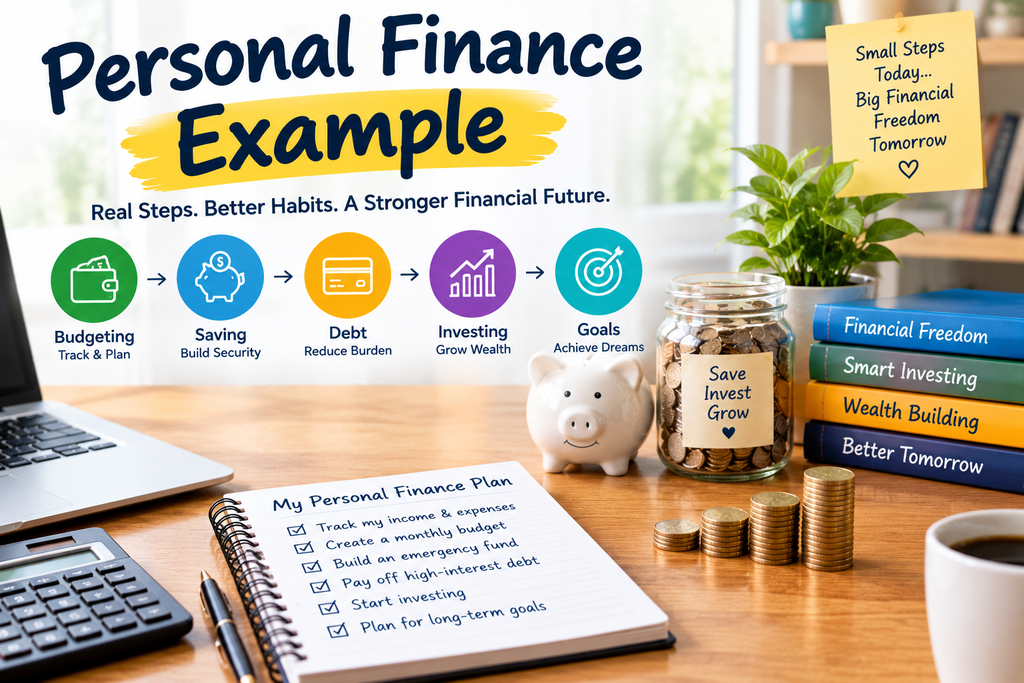
Managing money becomes much easier when you can see how the different pieces fit together. This personal finance example shows how a beginner can organize income, expenses, savings, debt, investing, and long-term goals into one practical financial plan.
Instead of looking at budgeting, saving, and investing as separate tasks, think of them as connected steps. Your budget creates cash flow, your savings provide protection, debt management frees up money, and investing gives long-term money an opportunity to grow.
The numbers used in the examples below are illustrations, not personalized financial advice. Your income, expenses, debt, family responsibilities, country, taxes, and financial goals can change what makes sense for you.
What Is a Personal Finance Example?
A personal finance example is a realistic illustration of how someone could manage their money over a specific period.
It usually includes:
- Income
- Monthly expenses
- Savings
- Emergency fund
- Debt
- Financial goals
- Investments
- Retirement planning
- Net worth
For example, imagine a person earns $4,500 per month after taxes.
Instead of simply spending whatever is available, that person could create a plan that assigns money to essential expenses, lifestyle spending, savings, debt repayment, and long-term investing.
That is the basic idea behind a personal finance example: showing how financial decisions work together rather than discussing each decision in isolation.
The U.S. Consumer Financial Protection Bureau recommends building a realistic picture of actual spending, including regular expenses as well as less frequent costs such as insurance, medical expenses, gifts, vacations, and other irregular expenses.
Personal Finance Example for Beginners
Let’s create a simple hypothetical example.
Imagine Alex, a 30-year-old employee who takes home $4,500 per month.
Alex has:
- $4,500 monthly take-home income
- $2,500 in essential expenses
- $500 in lifestyle spending
- $300 in debt payments
- $500 available for savings and investing
- $700 remaining for additional goals, debt payments, or flexible spending
The exact percentages are not important. The purpose is to understand how Alex can give every dollar a job.
Example Monthly Money Plan
| Category | Monthly Amount |
|---|---|
| Take-home income | $4,500 |
| Housing and utilities | $1,300 |
| Food and groceries | $500 |
| Transportation | $300 |
| Insurance and healthcare | $250 |
| Other essential costs | $150 |
| Lifestyle spending | $500 |
| Debt payments | $300 |
| Savings | $500 |
| Investing | $500 |
| Remaining flexible amount | $200 |
This is only an illustration. Real households may have very different housing costs, family responsibilities, taxes, debt payments, and financial priorities.
The important lesson is that Alex is not waiting until the end of the month to see what remains.
Instead, savings and investing are included in the plan from the beginning.
1. Start With Income and Expenses
The first step in almost every personal finance example is understanding cash flow.
Cash flow simply means looking at the money coming in and the money going out.
Start by identifying all sources of income.
These might include:
- Salary
- Freelance income
- Business income
- Rental income
- Bonuses
- Commissions
- Other regular income
Then list your expenses.
Separate them into categories such as:
Essential expenses
These are costs you generally need to keep your household functioning.
Examples include:
- Housing
- Utilities
- Groceries
- Transportation
- Insurance
- Healthcare
- Minimum debt payments
Flexible expenses
These are costs that can often change from month to month.
Examples include:
- Restaurants
- Entertainment
- Shopping
- Travel
- Hobbies
- Subscriptions
Financial goals
These include:
- Emergency savings
- Debt repayment
- Retirement contributions
- Long-term investing
- Home savings
- Education savings
This separation makes it easier to identify where your money is actually going.
2. Create a Realistic Budget
A budget is simply a plan for how you will use your income.
There is no single budget percentage that works for every household.
The popular 50/30/20 framework is one possible starting point, but it should not be treated as a universal rule. Your housing costs, income, debt and family situation may require a different structure.
For example, someone earning $3,000 per month in a high-cost city may have a very different budget from someone earning $6,000 with low housing costs.
A useful budget should answer three questions:
What must I pay?
What do I want to spend?
What should I save or invest?
A budget can also help create room for investing. Investor.gov recommends getting control of monthly expenses so you can make room for saving and investing.
A Simple Budget Example
Suppose someone takes home $5,000 per month.
They could create a plan such as:
- $2,700 for essential expenses
- $700 for lifestyle spending
- $600 for savings
- $700 for debt repayment
- $300 for investing
Again, this is not a recommended percentage for everyone.
It is simply an example of how someone might divide available cash according to their personal priorities.
3. Build an Emergency Fund
An emergency fund is one of the most important parts of a strong personal finance example.
It is money set aside for unexpected expenses or income disruptions.
Possible emergencies include:
- Job loss
- Major car repairs
- Unexpected medical bills
- Urgent home repairs
- Family emergencies
- Temporary loss of income
Investor.gov explains that savings can be appropriate for emergencies and short-term needs because the money remains accessible. It also notes that some people keep enough savings to cover up to six months of income.
A common planning approach is to calculate emergency savings using essential expenses.
For example, if your essential expenses are $2,500 per month:
- 3 months = $7,500
- 4 months = $10,000
- 6 months = $15,000
Your personal target could be different.
Someone with highly stable employment and multiple household incomes may have different needs from someone who is self-employed, has irregular income, or supports several dependents.
The key is to create a financial cushion before putting money needed for emergencies into investments that can fluctuate in value.
4. Manage High-Interest Debt
Debt is another major part of any useful personal finance example.
Not all debt has the same cost.
A credit card balance with a high interest rate can be much more expensive than a lower-rate loan.
Start by making a list of:
| Debt | Balance | Interest Rate | Minimum Payment |
|---|---|---|---|
| Credit Card | $3,000 | 24% | $100 |
| Personal Loan | $6,000 | 12% | $180 |
| Auto Loan | $12,000 | 7% | $300 |
The interest rate is important because it affects how expensive the debt becomes over time.
Two common repayment approaches are:
Debt Avalanche
Focus extra payments on the debt with the highest interest rate while continuing minimum payments on the others.
Debt Snowball
Focus extra payments on the smallest balance first while making minimum payments on other debts.
The avalanche method can reduce interest costs more directly, while the snowball method can provide quick psychological wins.
The most useful strategy is often the one you can consistently follow.
Investor.gov specifically recommends addressing high-interest credit-card debt as part of a wealth-building plan and notes that investment returns are not guaranteed to offset high-interest debt costs.
5. Separate Saving From Investing
One of the biggest lessons in this personal finance example is that saving and investing have different jobs.
Saving is generally for:
- Emergencies
- Near-term purchases
- Short-term goals
- Money you may need soon
Investing is generally for:
- Retirement
- Long-term wealth
- Long-term financial goals
- Money you can leave invested for years
Investor.gov explains that savings can be appropriate for short-term goals and emergency funds, while investing involves putting money into assets such as stocks or bonds with the expectation of earning a return over time. Investments involve risk and can fluctuate.
This distinction matters.
Imagine you need $10,000 for a home purchase next year.
That money has a very different time horizon from retirement money that you may not need for 30 years.
Putting all of your short-term money into risky investments could expose you to a loss at the wrong time.
6. Turn Your Budget Into an Investing Plan
Once your financial foundation is stronger, your budget can start supporting long-term investing.
This is where the personal finance example becomes a wealth-building example.
Suppose Alex has:
- Emergency savings in place
- High-interest debt under control
- Stable monthly cash flow
- $500 available for long-term goals
Alex could consider investing that $500 regularly rather than waiting for the “perfect” market moment.
Investor.gov explains that regular investing combined with time can support long-term wealth building. It also explains compound growth, where returns can generate additional returns over time.
Example
Suppose Alex invests $500 per month.
That means:
$500 × 12 = $6,000 per year
Over five years, ignoring investment returns, Alex would have contributed:
$30,000
Over 10 years:
$60,000
The actual account value could be higher or lower because investments fluctuate and returns are not guaranteed.
The important lesson is consistency.
7. Understand Compound Growth
Compound growth is one reason starting early can matter.
Investor.gov explains that compound growth occurs when you earn returns on your original investment and then potentially earn returns on those accumulated returns.
For example, imagine you invest $100 every month.
That may not feel significant at first.
But repeating that contribution for years creates a growing investment base.
Investor.gov provides an example showing how regular small savings can grow over long periods when returns are reinvested.
This does not mean investment returns are guaranteed.
Markets can decline, and different investments have different levels of risk.
The point is that time and consistency can be powerful components of a long-term investing strategy.
How a Personal Finance Example Connects Saving and Investing
Think of your money as having different jobs.
| Money Purpose | Possible Destination |
|---|---|
| Daily expenses | Checking account |
| Emergency fund | Accessible savings |
| Near-term goal | Appropriate low-risk savings |
| High-interest debt | Debt repayment |
| Retirement | Long-term investments |
| Long-term wealth | Diversified investment portfolio |
This framework prevents one common mistake: treating every dollar as if it should be invested.
Some money needs to remain safe and accessible.
Other money has a long time horizon and may be better suited to investing.
A good personal finance example should also include an emergency fund before putting too much money into long-term investments. Investor.gov explains that savings can help cover unexpected expenses, while investing may offer greater growth potential over longer periods but also involves more risk. For practical guidance on saving and investing, readers can visit Investor.gov’s saving and investing guide.
Personal Finance Example: From $0 to a Stronger Financial Foundation
Let’s create another simple example.
Imagine Sarah earns $4,000 per month.
At the beginning, she has:
- $500 in savings
- $4,000 in credit-card debt
- No regular investment contributions
Her first goal is not to build a huge investment portfolio immediately.
Instead, she creates a sequence.
Stage 1: Build a starter cash reserve
Sarah saves enough to handle smaller unexpected expenses.
Stage 2: Control high-interest debt
She directs additional cash toward the credit-card balance.
Stage 3: Build emergency savings
After the expensive debt is under control, she works toward several months of essential expenses.
Stage 4: Begin regular investing
Sarah then starts directing a consistent amount toward long-term goals.
Stage 5: Increase contributions
As her income grows, she increases savings and investment contributions.
This sequence is more realistic than assuming everyone should immediately invest every extra dollar.
Personal Finance Example for a Couple
Personal finance can become more complicated when two people share money.
Imagine a married couple earns $7,000 per month after taxes.
They might have:
- $2,800 essential expenses
- $800 lifestyle spending
- $800 debt repayment
- $1,000 emergency savings
- $1,000 retirement and long-term investments
- $600 toward short-term goals
The couple should also decide how they will handle:
- Shared bills
- Individual spending
- Emergency savings
- Retirement contributions
- Insurance
- Large purchases
- Debt
- Financial goals
There is no single correct way for couples to combine finances.
What matters is that both people understand the plan and know what their money is intended to accomplish.
Personal Finance Example for Someone With Irregular Income
Not everyone receives the same paycheck every month.
A freelancer or business owner may earn:
- $2,500 one month
- $4,000 the next month
- $6,000 during a strong month
- $1,800 during a slow month
In this situation, budgeting based on the highest income month can create problems.
A better approach may be to calculate average income over several months and maintain a larger cash cushion if appropriate.
During strong months, extra income can potentially go toward:
- Emergency savings
- Taxes
- Debt repayment
- Investing
- Future business expenses
This gives irregular income a more structured role.
Personal Finance Example With Financial Goals
A good financial plan should connect your money with actual goals.
Instead of saying:
“I want to save more.”
Create a specific target.
For example:
Short-term goal
Save $2,000 for an emergency reserve.
Medium-term goal
Save $10,000 for a home-related expense over three years.
Long-term goal
Invest $500 per month toward retirement.
Specific goals make it easier to determine how much money needs to be saved, how long you have, and where the money may belong.
The Securities and Exchange Commission’s Investor.gov also emphasizes defining financial goals and creating a plan for regular investing.
How Budgeting Creates Money for Investing
A budget does not magically create income.
What it can do is show where your existing income is being used.
Suppose someone earns $5,000 per month and spends:
- $3,500 on essential expenses
- $900 on lifestyle spending
- $600 on miscellaneous purchases
There is nothing left for investing.
After tracking expenses, they discover $200 in subscriptions, unnecessary fees and impulse spending.
Reducing those costs creates $200 of monthly cash flow.
That $200 could then be directed toward:
- Emergency savings
- Debt repayment
- Retirement
- Long-term investing
This is why budgeting and investing are closely connected.
For another practical budgeting guide, see our WealthNivo article “What Can a Budget Help You Do?” What Can a Budget Help You Do?
How Savings Can Support Investing
Savings and investing should not be viewed as enemies.
Savings can protect your investment plan.
Imagine you invest $20,000 but have no emergency fund.
Then your car needs a $4,000 repair.
If you do not have accessible cash, you may have to sell investments at an inconvenient time or take on expensive debt.
An emergency fund can reduce that pressure.
This is why Investor.gov recommends maintaining emergency savings while also investing regularly for long-term goals.
For more detail, read our WealthNivo guide on “How Much Should Be in Savings?” How Much Should Be in Savings?
What Should You Invest In?
There is no single investment that is right for everyone.
Common investment categories include:
- Stocks
- Bonds
- Mutual funds
- ETFs
- Retirement accounts
- Other investment assets
Your choice should depend on factors such as:
- Time horizon
- Risk tolerance
- Financial goals
- Diversification
- Fees
- Tax considerations
- Personal circumstances
Investor.gov explains that diversification means spreading money among different investments to reduce concentration risk. It cannot guarantee that a portfolio will avoid losses, but it can reduce the impact of one investment performing poorly.
Beginners should focus on understanding what they own instead of chasing whatever investment is receiving the most attention online.
A Simple 12-Month Personal Finance Example
Here is how someone could structure a first year.
| Month | Main Focus |
|---|---|
| 1 | Track income and expenses |
| 2 | Create a realistic budget |
| 3 | Start emergency savings |
| 4 | Review and reduce unnecessary expenses |
| 5 | Create a debt repayment plan |
| 6 | Automate savings |
| 7 | Increase emergency fund |
| 8 | Learn basic investing concepts |
| 9 | Start or increase long-term investing |
| 10 | Review insurance and financial protection |
| 11 | Check net worth |
| 12 | Review the entire financial plan |
This does not mean every person should follow this exact timeline.
Some people may need to focus heavily on debt first. Others may already have emergency savings and can move faster toward investing.
The value of this personal finance example is that it demonstrates a process.
Track Your Net Worth
Income is important, but it does not tell the whole story.
Net worth is calculated as:
Net Worth = Assets − Liabilities
Assets may include:
- Cash
- Savings
- Investments
- Retirement accounts
- Property
- Other valuable assets
Liabilities may include:
- Credit cards
- Personal loans
- Auto loans
- Student loans
- Mortgages
For example:
Assets = $100,000
Liabilities = $40,000
Net worth = $60,000
Tracking this number over time can help you see whether your financial position is improving.
You do not need to check it every day.
A quarterly or annual review may be enough for many people.
Common Mistakes to Avoid
A good personal finance example should also show what not to do.
Investing emergency money
Money needed for emergencies should generally remain accessible rather than being exposed to unnecessary market risk.
Ignoring high-interest debt
Expensive debt can reduce the amount of money available for future investing.
Spending every raise
Higher income does not automatically create wealth if expenses rise at the same speed.
Chasing guaranteed returns
Be cautious when someone promises easy, guaranteed investment profits.
Investments involve risk.
Having no financial goals
Saving without a purpose can make it difficult to decide how much you actually need.
Copying someone else’s portfolio
Another person’s investments may not match your time horizon, risk tolerance or financial objectives.
Trying to become wealthy quickly
Building wealth is usually a long-term process.
Consistency is often more important than finding a perfect financial move.
A Practical Personal Finance Checklist
Use this checklist to review your own financial situation:
- I know my monthly take-home income.
- I track my major expenses.
- I have a realistic budget.
- I am building emergency savings.
- I know how much debt I owe.
- I know my debt interest rates.
- I have a plan for high-interest debt.
- I save automatically.
- I understand the difference between saving and investing.
- I have clear financial goals.
- I understand the investments I own.
- I am considering diversification.
- I am planning for retirement.
- I review my net worth.
- I look for ways to increase my income.
You do not need every box checked immediately.
The purpose is to identify the next financial step.
Personal Finance Example: The Bigger Picture
A strong personal finance example is not really about one perfect budget.
It is about how different financial decisions connect.
Your income creates cash flow.
Your budget organizes that cash flow.
Your savings provide a financial cushion.
Debt management prevents interest costs from consuming too much of your income.
Investing gives long-term money the opportunity to grow.
Retirement planning prepares for the future.
Tracking net worth helps you measure the overall direction of your finances.
That is why personal finance is more than simply “saving money.”
It is a system.
Final Thoughts
The most useful personal finance example is one that you can adapt to your own life.
You may not earn $4,500 per month like the example above. Your rent may be higher, your income may be irregular, or you may have family responsibilities that change your priorities.
That is completely normal.
Start with the numbers you actually have.
Know your income. Track your spending. Build appropriate emergency savings. Deal with expensive debt. Set specific financial goals. Then consider regular investing for money you can leave invested for the long term.
The goal is not to create a perfect financial plan once and never change it.
Your income, expenses, goals and responsibilities will change.
Your financial plan should change with them.
What matters most is building money habits that help you consistently move from earning → budgeting → saving → managing debt → investing → building long-term wealth.