Single Parent Budget 2026: A Proven, Stress-Free Guide
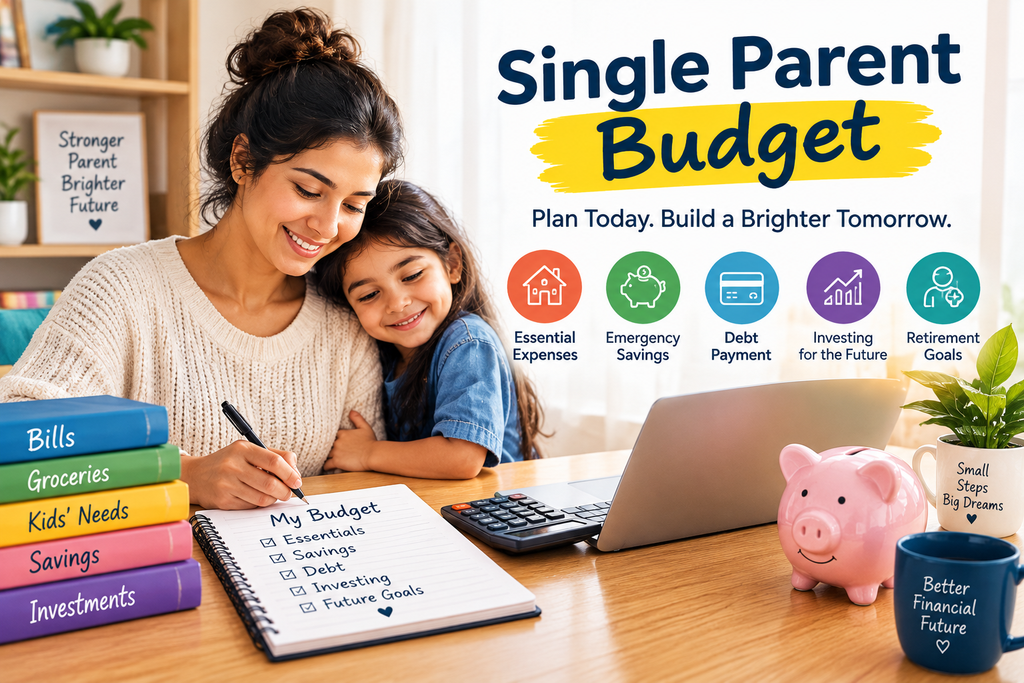
A single parent budget works best when it starts from your actual income and expenses, not a formula built for a two-income household. The starting point is knowing exactly where your income sits relative to federal benchmarks, since that number determines which assistance programs are even on the table before you build the rest of the plan.
Single Parent Budget 2026 (Quick Facts)
| Question | Answer | Source |
|---|---|---|
| 2026 poverty guideline, family of 3 | $27,320/year | HHS 2026 Poverty Guidelines |
| 2026 poverty guideline, family of 4 | $33,000/year | HHS 2026 Poverty Guidelines |
| SNAP eligibility threshold | Generally 130% of the poverty guideline | HHS/USDA program rules |
| Households headed by women (single-parent families) | 80% | U.S. Census Bureau |
| Starter emergency fund target | $500-$1,000 before anything else | Common financial-planning benchmark |
| Recommended long-term savings rate | 15-20% of income, once stable | Common financial-planning benchmark |
Start With Your Real Number, Not a Percentage Rule
The classic 50/30/20 budgeting rule assumes two incomes covering one household’s needs. On a single income, needs routinely eat past 50%, and treating that as a personal failure instead of a math problem is one of the fastest ways a single parent budget falls apart in month one.
Instead, start with the 2026 HHS poverty guidelines for your household size — $27,320 for a family of three, $33,000 for a family of four in the 48 contiguous states. These numbers aren’t a judgment on your situation; they’re the reference point nearly every assistance program uses to determine what you qualify for.
Knowing where your income sits relative to that guideline changes the whole plan. A single parent budget built without checking eligibility for available assistance is often working with less than it needs to.
Government Assistance Most Single Parents Qualify For (and Miss)
A meaningful part of a realistic single parent budget is knowing which programs exist before assuming income has to stretch to cover everything alone. Eligibility rules and dollar amounts vary by state and household size, so the numbers below are national starting points, not guarantees — but they’re worth checking against your own situation before ruling anything out. The major ones:
SNAP (food assistance). Eligibility is generally based on gross income at or below 130% of the poverty guideline, with net income tests after deductions. Benefits are loaded onto an EBT card usable at most grocery stores.
Medicaid and CHIP. Health coverage for parents and children, with income limits that vary by state — in Medicaid expansion states, working adults often qualify with income noticeably higher than the poverty guideline itself.
TANF (Temporary Assistance for Needy Families). Monthly cash assistance for low-income households with children, with amounts and rules that vary significantly by state.
WIC. Nutrition support for pregnant women and children under five, with a higher income threshold than SNAP in most cases.
The Child Tax Credit and Earned Income Tax Credit. Refundable tax credits that can meaningfully change your effective annual income — the IRS’s EITC page covers current eligibility rules and income limits.
LIHEAP. Assistance with home heating and cooling costs, run through state agencies with their own income cutoffs.
Applying takes time most single parents don’t feel they have, but skipping this step means building a budget around less income than the household is actually entitled to — often by a meaningful margin once tax credits are factored in alongside direct assistance.
Budgeting the Expenses That Don’t Show Up Monthly
Standard budgets track rent, groceries, and utilities well, but they routinely miss irregular expenses — the ones that hit once or twice a year and quietly wreck an otherwise solid plan. School supplies, holiday costs, car registration, and seasonal clothing all fall into this category.
The fix is simple in concept: total the annual cost of each irregular expense, divide by 12, and treat that monthly amount as a fixed budget line, funded automatically alongside rent and utilities. A $600 back-to-school and holiday combined cost becomes a $50 monthly line item instead of a crisis in August and December — the same amount of money, just spread out before it’s needed instead of scrambled for after.
Childcare deserves its own dedicated line rather than living inside “miscellaneous.” For many single-parent households, it’s the second-largest expense after housing, and an inaccurate estimate here throws off the entire budget.
Budgeting When Income Isn’t the Same Every Month
Hourly wages, gig work, seasonal jobs, and inconsistent child support payments all make a fixed monthly budget harder to build — and harder to trust once it’s built. A single parent budget that assumes every month looks like the best month is set up to fail in the months that don’t.
One approach that holds up better: build the budget around your lowest realistic monthly income, not your average. Essential expenses get covered by that baseline number, and anything earned above it in a stronger month goes toward the irregular-expense fund, the emergency fund, or debt payoff — not toward expanding what counts as “essential.” This keeps a strong month from quietly resetting expectations for what a normal month looks like.
This also means tracking income month to month rather than assuming a single number applies year-round. A budget reviewed and adjusted quarterly tends to hold up far better than one set once and left alone, especially when work hours or child support payments fluctuate from one season to the next.
Small Ways to Add Income Without Overcommitting Time
For a lot of single parents, cutting expenses only goes so far before it starts cutting into things that matter — and the other side of the budget is income, not just spending. A few ways this gets added without requiring a second full-time job:
- Flexible, part-time work that fits around childcare hours, rather than a rigid schedule that creates new childcare costs to cover the new income.
- Selling unused items around the house — a one-time boost that can fund a starter emergency fund faster than waiting to save it from a monthly budget.
- Freelance or skill-based work done during non-childcare hours, even a few hours a week, which tends to be more sustainable than an inflexible second job.
- Checking for underused tax credits before assuming the only lever is earning more — the Child Tax Credit and Earned Income Tax Credit can add up to a meaningful annual amount that doesn’t require any additional working hours at all.
None of these need to solve the whole budget gap by themselves. Even a modest addition, applied consistently, changes how much pressure sits on the fixed-expense side of the plan.
Building the Emergency Fund Without Ignoring Everything Else
An emergency fund matters more on a single income specifically because there’s no second earner to fall back on if a job is disrupted. Start with a small target — $500 to $1,000 — before worrying about the fuller 3-to-6-month goal.
Our guide to how much you should keep in savings walks through exactly how that starter fund gets built and where to keep it once it exists, including why a standard low-interest savings account isn’t the right long-term home for it.
Once the starter fund is in place, the priority doesn’t have to be “max out savings before investing anything.” Small, automated retirement contributions — even capturing just an employer match — can run alongside a growing emergency fund rather than waiting for one to finish before the other starts, a point covered in more detail in our breakdown of how much you should have saved by 40.
Common Budgeting Mistakes That Set Single Parents Back
Treating child support as guaranteed, fixed income. Payments can be inconsistent even when legally owed, and building a budget that assumes 100% on-time payment every month creates avoidable shortfalls.
Skipping the assistance application because “I probably don’t qualify.” Income limits for programs like Medicaid and SNAP are often higher than people expect, and applying costs nothing but time.
Not accounting for irregular expenses at all. A budget that only tracks monthly recurring costs will be broken by every annual expense it didn’t plan for.
Letting the emergency fund and investing compete as an either/or choice. Waiting for a “fully funded” emergency fund before contributing anything to retirement can cost years of compounding that are hard to make up later.
Skipping life insurance. For a household depending on one income, life insurance isn’t optional spending — it’s part of protecting the financial plan itself if something happens to the primary earner.
A Realistic Order of Operations
When money is tight, the order matters as much as the amounts. A workable sequence for most single-parent households:
- Cover essential needs and debt minimums first.
- Apply for and claim every assistance program and tax credit you’re eligible for.
- Build the $500-$1,000 starter emergency fund.
- Capture any available employer retirement match, even at a small percentage.
- Grow the emergency fund toward 3-6 months of expenses while investing continues in the background.
- Increase savings and investing contributions gradually as income grows or expenses drop.
This order isn’t about doing everything perfectly at once — it’s about making sure the next available dollar goes where it does the most good, especially in months where there isn’t much left over after essentials are covered.
None of this works as a one-time exercise. Income changes, childcare costs shift, and assistance program eligibility can change year to year — a single parent budget that gets reviewed every few months holds up far better than one built once and forgotten. The goal isn’t a perfect budget on the first try; it’s a plan that’s honest about the real numbers and adjusts as life does.
Frequently Asked Questions
What is a realistic budget for a single parent? One built around actual income and essential expenses for your household size, informed by the current federal poverty guidelines rather than a generic two-income budgeting rule.
What percentage of income should a single parent spend on housing? There’s no universal number — housing often exceeds the classic 30% guideline on a single income, which is common and not a sign the budget is failing.
What government assistance is available to single parents? Common programs include SNAP, Medicaid or CHIP, TANF, WIC, LIHEAP, and refundable tax credits like the Child Tax Credit and Earned Income Tax Credit.
How much should a single parent save for emergencies? Start with $500-$1,000, then build toward 3-6 months of essential expenses over time, ideally alongside investing rather than strictly before it.
Does child support count as income for budgeting? It can be included, but because payments aren’t always consistent, it’s safer to budget essential expenses around guaranteed income and treat child support as a supplement when it arrives reliably.
What is the biggest budgeting mistake single parents make? Skipping available government assistance and tax credits out of an assumption they won’t qualify, which often leaves real money unclaimed.
Should a single parent invest or focus only on savings? Both can run together — a small starter emergency fund first, then investing (especially any employer match) alongside a growing emergency fund, rather than one strictly before the other.
How do irregular expenses fit into a monthly budget? Divide the annual cost of each irregular expense by 12 and treat that amount as a fixed monthly budget line, so it’s funded gradually instead of appearing as a surprise.