Variable Annuity vs Fixed Annuity: 7 Smart Key Differences
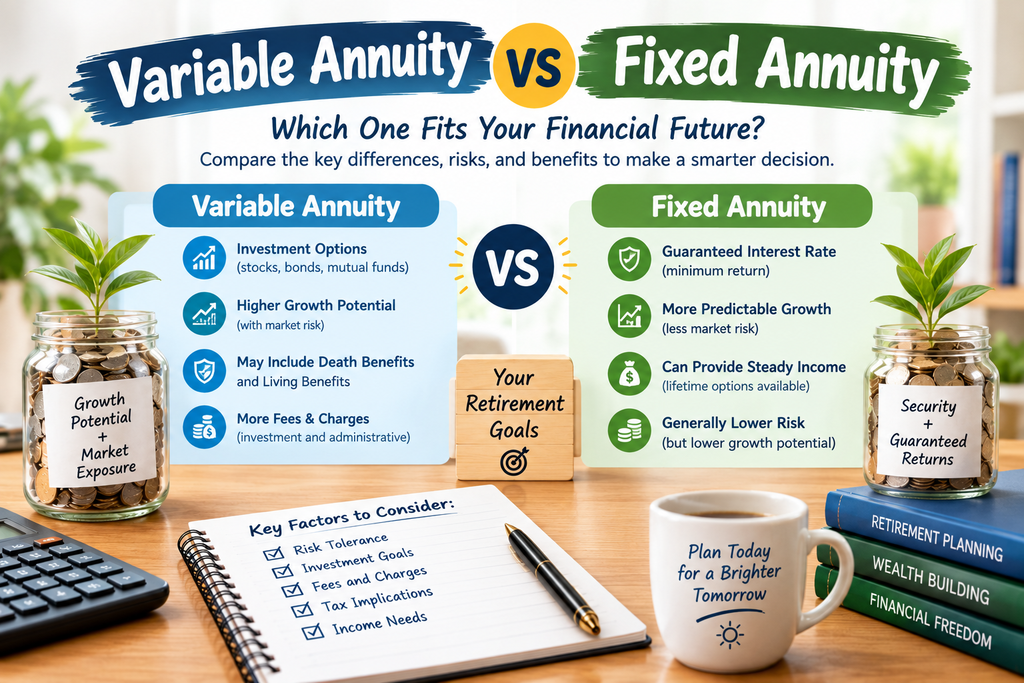
Understanding variable annuity vs fixed annuity comes down to one central question: how do you want your retirement money to grow, and how much investment risk are you willing to accept?
A fixed annuity generally provides a guaranteed minimum interest rate during its accumulation period, while a variable annuity lets you allocate money among investment options whose performance can cause the contract value to rise or fall. Both are insurance contracts designed for long-term financial goals, but their risk, return potential, fees, liquidity, and income features can be very different.
That difference matters because an annuity is not simply another savings account or mutual fund. It is a contract with an insurance company, and the specific terms can affect what you pay, how your money grows, when you can access it, and what income benefits may eventually be available.
This guide breaks down the variable annuity vs fixed annuity comparison in plain language so you can understand the major differences before evaluating an annuity contract.
What Is an Annuity?
An annuity is a contract between an individual and an insurance company. You make either a single payment or a series of payments, and the insurer provides benefits according to the contract. Depending on the type, those benefits can include tax-deferred accumulation, periodic income payments, death benefits, or other insurance features.
Annuities can be structured in several ways. The SEC’s Investor.gov explains that deferred annuities generally allow money to accumulate before income payments begin, while immediate annuities generally begin making payments relatively soon after purchase.
The two products compared in this article—fixed and variable annuities—also differ in how the contract value is determined.
With a fixed annuity, the insurer guarantees at least a minimum interest rate during the accumulation phase. With a variable annuity, the contract value depends largely on the performance of investment options selected by the owner.
Variable Annuity vs Fixed Annuity: Quick Comparison
| Feature | Fixed Annuity | Variable Annuity |
|---|---|---|
| Basic structure | Insurance contract with guaranteed minimum interest | Insurance contract with investment subaccounts |
| Growth | Based on guaranteed or declared interest | Based on selected investment options |
| Market exposure | Generally no direct stock-market exposure | Yes, through investment subaccounts |
| Account value | Generally more predictable | Can rise or fall with investments |
| Investment risk | Generally lower | Can be moderate to very high depending on investments |
| Growth potential | Generally more limited | Potentially higher, but with greater risk |
| Fees | Contract-specific; may include surrender charges | May include several ongoing and contract-related charges |
| Tax treatment | Tax-deferred when applicable | Tax-deferred when applicable |
| Liquidity | May be restricted during surrender period | May be restricted during surrender period |
| Insurance features | May provide guaranteed income and other benefits | May offer death benefits and optional living benefits |
These are general characteristics. Actual terms vary by contract, insurer, state, account type, and selected features. Investor.gov specifically recommends reviewing the individual contract because annuities can have substantially different costs, risks, and benefits.
1. How the Money Grows
One of the biggest differences in the variable annuity vs fixed annuity comparison is the way returns are determined.
A fixed annuity guarantees a minimum interest rate during the accumulation period. The insurer sets the rate, and a contract may credit more than the guaranteed minimum depending on its terms.
A variable annuity works differently. Your money is allocated among investment options, commonly called subaccounts. These may invest in stocks, bonds, money-market instruments, or combinations of investments. The value of your contract changes according to the performance of the options you select, after applicable fees and expenses.
For example, suppose two people each place $50,000 into different annuity contracts.
The person using a fixed annuity may receive interest according to the contract’s guaranteed rate. The person using a variable annuity may see the account value increase or decrease depending on the performance of the selected investment options.
Neither example guarantees a specific final balance unless the contract itself provides a particular guarantee.
2. Investment Risk Is Different
Risk is another major difference.
A fixed annuity generally offers more predictable accumulation because the insurer guarantees a minimum interest rate. Investor.gov describes fixed annuities as products that guarantee that money will earn at least a minimum interest rate during the accumulation phase.
A variable annuity exposes the contract value to investment performance.
If the underlying investment options perform well, the account value can increase. If those investments lose value, the account value can decline. Investor.gov specifically states that the value of a variable annuity varies according to the performance of the investment options selected.
This creates an important trade-off:
Fixed annuity: greater emphasis on predictable interest and protection from direct market fluctuations.
Variable annuity: greater exposure to investment markets and potentially greater growth, along with the possibility of losses.
The actual risk of a variable annuity depends heavily on the investment options selected and the contract features attached to it.
3. Growth Potential Can Be Different
A fixed annuity generally trades some growth potential for greater predictability.
The insurer credits interest according to the contract, subject to its guaranteed minimum and other terms. Because the return structure is more predictable, the contract does not provide the same direct market participation as a variable annuity.
A variable annuity provides access to investment subaccounts, which can include stock and bond funds. This creates more potential for investment growth when markets perform well, but it also creates the possibility of losses.
This is an important point for retirement planning.
A higher potential return does not mean a higher guaranteed return.
If someone is comparing a fixed and variable annuity, they should look at the actual contract terms rather than assuming that the product with greater investment exposure will automatically produce a better outcome.
Past investment performance also does not guarantee future results.
4. Fees Can Make a Major Difference
Fees deserve close attention when comparing annuities.
Variable annuities can have multiple types of expenses, including investment-related expenses, administrative charges, mortality and expense charges, surrender charges, and charges for optional benefits or riders. The SEC advises investors to review the prospectus carefully for fees, charges, investment options, death benefits, and payout provisions before buying a variable annuity.
The SEC also explains that surrender charges can apply when money is withdrawn during an early period of the contract.
Fixed annuities can also have surrender charges and other contract-specific costs. Investor.gov advises investors to ask about upfront, surrender, ongoing, and implicit fees when evaluating annuities.
This means you should not compare two annuities simply by looking at their advertised interest rate or projected return.
Look at:
- Surrender charges
- Annual contract charges
- Investment expenses
- Rider costs
- Administrative fees
- Mortality and expense charges
- Withdrawal restrictions
- Potential tax consequences
- Any sales-related costs
A difference in fees can affect how much money remains in the account over a long period.
5. Tax-Deferred Growth
Both fixed and variable annuities can provide tax-deferred growth under applicable tax rules.
Tax deferral means taxes generally are not due each year on investment gains inside the annuity. Instead, taxation generally occurs when money is withdrawn or income payments are received, subject to the rules that apply to the specific contract.
Variable annuities receive similar tax-deferred treatment. Investor.gov explains that federal taxes generally are not paid on income and investment gains from a variable annuity until withdrawals, income payments, or certain death benefits occur.
However, tax deferral does not mean that all withdrawals are tax-free.
For example, the IRS states that taxable portions of distributions from annuity contracts can be treated as ordinary income, depending on the contract and distribution circumstances. Early distributions before age 59½ can also be subject to an additional 10% tax unless an exception applies.
Because tax treatment can vary based on whether the annuity is qualified or nonqualified and how distributions are taken, tax rules should be reviewed before making a large withdrawal.
6. Liquidity and Surrender Charges
Annuities are generally designed for long-term financial goals rather than short-term cash needs.
This is one of the most important points to understand before purchasing either type.
Investor.gov notes that surrender charges may apply when an investor withdraws or surrenders an annuity during the surrender-charge period. The length and terms of that period vary by contract.
For example, imagine someone purchases an annuity and later needs a large amount of money for an unexpected expense.
The contract might permit some withdrawals without a surrender charge, but the exact allowance depends on the contract. Taking more than the permitted amount could result in charges.
A variable annuity can also involve additional tax considerations when money is withdrawn before age 59½. Investor.gov notes that a 10% federal tax penalty may apply to certain early withdrawals.
That is why emergency savings and annuities should not automatically be treated as the same type of financial resource.
For money that may be needed immediately, accessibility is an important consideration.
7. Income and Insurance Features
Annuities can be used as part of a retirement-income strategy because they can provide periodic payments under the terms of the contract.
Investor.gov explains that annuities can provide income for a specific period or potentially for life, depending on the contract and payout selection.
Variable annuities can also include insurance features such as death benefits and optional benefits that may provide certain lifetime withdrawal or income features. These features can add costs, and the specific guarantees depend on the contract.
Fixed annuities can also be structured to provide fixed income payments for a specific period or lifetime under the contract terms. Investor.gov defines a fixed annuity as an insurance product that promises a minimum interest rate during accumulation and can provide a set payment for a specified period or lifetime.
The key is to distinguish between:
Account growth — how the money accumulates.
Income guarantee — what the contract may pay under specified conditions.
These are not necessarily the same thing.
Fixed Annuity vs Variable Annuity: Advantages and Trade-Offs
Instead of asking which annuity is universally better, it is more useful to understand the trade-offs.
Fixed Annuity Characteristics
A fixed annuity may provide:
- A guaranteed minimum interest rate
- More predictable accumulation
- Less direct exposure to stock-market movements
- Tax-deferred growth under applicable rules
- Potential future income payments
- Insurance-company guarantees subject to the insurer’s claims-paying ability
The trade-off is that the return structure is generally less connected to market growth than a variable annuity.
Variable Annuity Characteristics
A variable annuity may provide:
- Investment subaccounts
- Exposure to stocks and bonds
- Greater growth potential
- Tax-deferred growth
- Death benefits
- Optional living or income benefits
- Greater investment flexibility
The trade-off is market risk and potentially more complicated fees and contract features.
Fixed Annuity vs Variable Annuity: Which Risk Is Right for Your Goal?
The answer depends on what the money is supposed to accomplish.
If the main concern is predictable accumulation and reduced exposure to market fluctuations, the structure of a fixed annuity may be relevant.
If the objective includes market participation and the investor can accept fluctuations in account value, a variable annuity may provide more direct exposure to investment performance.
However, this should not be reduced to a simple risk label.
A variable annuity with conservative investment options can have a different risk profile from one heavily allocated to stocks. Similarly, fixed annuity contracts can have different surrender periods, interest-crediting structures, income provisions, and withdrawal rules.
The contract matters.
Fixed Annuity vs Variable Annuity vs Fixed Indexed Annuity
One common source of confusion is treating fixed indexed annuities as the same thing as traditional fixed annuities.
They are different structures.
A fixed indexed annuity generally credits interest using a formula linked to an external index. The index might be the S&P 500 or another benchmark, but the owner’s money is not necessarily directly invested in that index. The contract can use features such as participation rates, caps, or spreads to determine how interest is credited.
A variable annuity, by contrast, provides investment options through subaccounts, and the contract value changes with their performance.
So when researching variable annuity vs fixed annuity, make sure you know whether a comparison is actually discussing:
- Fixed annuity
- Fixed indexed annuity
- Variable annuity
- Registered index-linked annuity
These products can have substantially different risk and return structures.
How Fees Can Affect Long-Term Results
Consider a hypothetical example.
Suppose an investor has $100,000 in a retirement product and the underlying investments produce a hypothetical 6% gross annual return.
If one arrangement has significantly higher ongoing costs than another, the amount remaining after fees will differ over time.
This does not mean the lowest-fee product is automatically the right choice. A fee can pay for an insurance benefit, income guarantee, death benefit, or another feature that an investor may value.
The correct question is:
What am I paying, and what am I receiving in return?
Investor.gov specifically recommends asking about all applicable fees and limits on investment performance before purchasing an annuity.
The SEC also recommends reading the variable annuity prospectus carefully because it contains important information about fees, investment options, insurance features, and payout options.
How to Evaluate an Annuity Contract
Before signing an annuity contract, create a simple checklist.
1. Check the guaranteed rate
For a fixed annuity, determine what interest rate is guaranteed and for how long.
2. Understand the investment options
For a variable annuity, review the available subaccounts and their expenses.
3. Review all fees
Do not rely only on the headline fee. Check contract charges, investment expenses, riders, and surrender charges.
4. Check the surrender period
Find out how long withdrawals may be subject to surrender charges.
5. Understand withdrawal rules
Ask how much you can withdraw and whether withdrawals affect future benefits.
6. Review income provisions
Understand when income begins, how payments are calculated, and whether payments can last for life.
7. Review death benefits
Find out what happens to the contract if the owner dies.
8. Check the insurer’s financial strength
An annuity is an insurance contract, so the insurer’s financial strength and claims-paying ability matter. Investor.gov emphasizes that the insurer’s financial strength affects its ability to meet contractual obligations.
9. Understand the tax treatment
Review how contributions, withdrawals, gains, and income payments will be treated under the applicable tax rules.
10. Read the complete contract
Do not base a major financial decision solely on an advertisement or sales presentation.
How This Fits Into a Broader Investing Plan
Annuities are only one part of retirement planning.
Before deciding how much money to place into an annuity, consider the rest of your financial picture.
You may need to account for:
- Emergency savings
- High-interest debt
- Employer retirement plans
- IRAs
- Taxable investments
- Insurance coverage
- Expected retirement expenses
- Social Security or other income
- Desired retirement age
- Liquidity needs
For example, someone who has very little emergency savings may have a different liquidity requirement from someone who already has a substantial cash reserve.
Our guide on How Much Should Be in Savings? explains how emergency savings can fit into a broader saving and investing strategy.
Similarly, retirement benchmarks can provide context when reviewing how much you have accumulated for the future. See How Much Should You Have Saved for Retirement at 35? for an age-based retirement-savings discussion.
For people focused on building investment habits gradually, How to Build Wealth With $100 a Month explains how small recurring contributions can fit into a long-term wealth-building plan.
Questions to Ask Before Buying a Variable or Fixed Annuity
Before committing money, consider asking the insurer or financial professional:
- What is the guaranteed interest rate?
- How long is the guarantee valid?
- What happens after the guaranteed period ends?
- What are all annual and contract fees?
- Is there a surrender charge?
- How long does the surrender period last?
- How much can I withdraw without a charge?
- What happens if I need the money early?
- What investment options are available?
- What are the expenses of those investment options?
- What income benefits are guaranteed?
- What happens to the contract when I die?
- How are withdrawals taxed?
- Is the annuity being purchased inside a retirement account?
- What alternatives should I compare before making a decision?
The SEC recommends asking detailed questions and reviewing the prospectus for variable annuities before purchase.
Common Mistakes to Avoid
Mistake 1: Looking Only at the Advertised Return
A headline rate does not tell you everything about an annuity.
Read the complete contract and understand guarantees, fees, surrender periods, and income provisions.
Mistake 2: Ignoring Liquidity
Annuities are generally long-term products. A surrender charge can make early access more expensive.
Mistake 3: Assuming Fixed Means Completely Risk-Free
A fixed annuity may protect against market losses under its contract terms, but it is still an insurance contract. The insurer’s financial strength and ability to meet its obligations matter.
Mistake 4: Assuming Variable Means Guaranteed Growth
Variable annuities expose the contract value to investment performance. The account can lose value when the underlying investments decline.
Mistake 5: Forgetting Fees
Variable annuities can have multiple layers of costs, and even fixed annuities can include contract-specific charges.
Mistake 6: Ignoring Taxes
Tax deferral can be useful, but withdrawals and income payments can create taxable income depending on the circumstances. Early distributions may also trigger additional taxes.
Variable Annuity vs Fixed Annuity: Final Takeaway
The main difference in the variable annuity vs fixed annuity comparison is how the contract’s value grows and how much investment risk the owner accepts.
A fixed annuity generally provides a guaranteed minimum interest rate and more predictable accumulation. A variable annuity provides investment options whose performance can increase or decrease the contract value.
But the comparison should go beyond returns.
Before making a decision, examine fees, surrender charges, liquidity, tax treatment, income guarantees, investment options, death benefits, and the insurer’s financial strength.
An annuity can be a complex long-term financial product. The right way to evaluate one is to understand exactly what the contract promises, what it costs, and what restrictions apply.
For official investor information, you can review the SEC’s Investor.gov annuity guide, which explains annuity types, risks, costs, and questions investors should consider.
Important: This article is for educational purposes and does not provide individualized investment, insurance, legal, or tax advice. Annuity terms vary by contract and jurisdiction. Review the actual contract and consider qualified professional advice before making a significant financial decision.