What Is a Custodial Roth IRA? 7 Powerful Facts for Parents
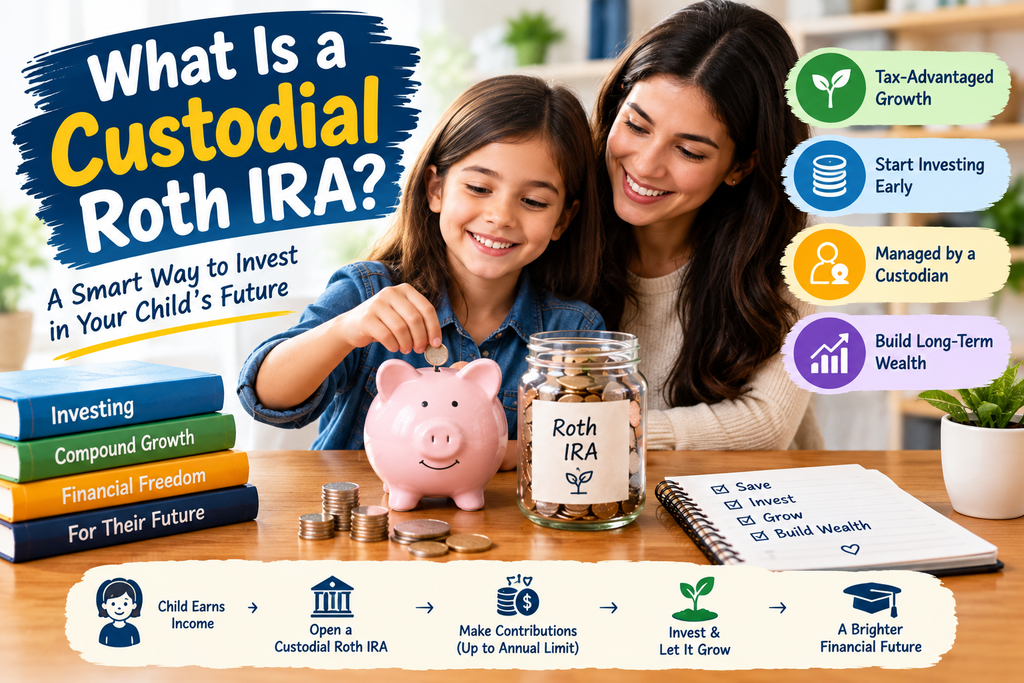
If you are wondering what is a custodial Roth IRA, it is a Roth individual retirement account opened for a minor and managed by an adult custodian. The child owns the account, but a parent or another qualified adult generally manages it until the child reaches the age required under applicable state law.
The most important requirement is that the child must have earned income. For 2026, total contributions to traditional and Roth IRAs are generally limited to $7,500 or the child’s taxable compensation for the year, whichever is lower.
That makes a custodial Roth IRA different from a regular savings account or a college savings account. It is designed primarily for retirement investing, but starting early can give a young investor decades for contributions and investment returns to potentially compound.
This guide explains how a custodial Roth IRA works, who can contribute, what counts as earned income, how the 2026 limits work, what happens when the child becomes an adult, and why starting early can matter for long-term investing.
What Is a Custodial Roth IRA?
A custodial Roth IRA is a Roth retirement account owned by a minor but managed by an adult custodian.
The custodian is commonly a parent or guardian. The adult handles the account while the child is a minor, including decisions related to contributions and investments. When the child reaches the applicable age of majority or termination age, control of the account transfers to the child. The exact age can vary by state and account arrangement.
The account itself is still the child’s. The parent does not simply own the money and later give it to the child. Contributions are made for the benefit of the child, and the assets belong to that child.
The Roth structure also matters.
Unlike a traditional IRA, Roth IRA contributions are made with after-tax money. If the applicable requirements for a qualified distribution are satisfied, withdrawals can generally be made tax-free. Investment earnings inside the account can therefore potentially grow without current federal income tax, subject to Roth IRA rules.
How Does a Custodial Roth IRA Work?
The basic process is easier to understand when you break it into a few steps.
1. The child earns money
The child must have compensation from work before a contribution can be made.
This could come from a traditional job, such as working at a store or restaurant, or from qualifying self-employment activities. Depending on the circumstances, examples can include babysitting, pet sitting, lawn care or other legitimate work.
The key point is that the income must actually qualify as earned income for IRA purposes.
2. An adult opens the account
Because a minor generally cannot establish and control their own IRA in the same way an adult can, a parent or another adult serves as the custodian.
The custodian manages the account for the child until the applicable transfer age.
3. Money is contributed
The contribution can come from the child or from someone else on the child’s behalf.
For example, imagine a teenager earns $3,000 during a summer job. A parent could provide the money for the Roth IRA contribution while the child keeps their earned income for other purposes. The important limitation is that total IRA contributions cannot exceed the child’s eligible compensation or the annual IRA limit, whichever is lower.
4. The money is invested
A Roth IRA is an investment account, not simply a place where cash sits.
Depending on the provider, investments may include stocks, bonds, mutual funds and exchange-traded funds. The custodian generally makes the investment decisions while the child is still a minor.
5. Control eventually transfers to the child
When the child reaches the applicable age, the custodial arrangement ends and the child takes control of the account.
The exact age can differ depending on state law. Some custodial arrangements transfer at 18 or 21, while certain states may allow a later age.
Who Can Open a Custodial Roth IRA for a Child?
A parent or guardian can generally establish a custodial Roth IRA for an eligible minor, although the specific account-opening requirements depend on the financial institution.
The important distinction is that the child is the account owner, while the adult serves as custodian.
A parent also does not necessarily have to be the source of every dollar contributed. According to Fidelity and Charles Schwab, contributions can be made by the child or by another person, provided the total contribution stays within the applicable limits and the child has sufficient eligible earned income.
This creates an interesting opportunity for families.
Suppose a 16-year-old earns $4,000 from a summer job. The family could decide that the teenager keeps the $4,000 for spending and saving goals while a parent contributes up to $4,000 to the child’s custodial Roth IRA.
The contribution still cannot exceed the child’s eligible earned income.
What Counts as Earned Income for a Custodial Roth IRA?
Earned income is one of the most important parts of understanding what is a custodial Roth IRA because a child cannot simply receive money from a parent and treat it as compensation.
Eligible income generally comes from work performed by the child.
Examples can include:
- Wages from an employer
- Salaries
- Certain self-employment income
- Babysitting
- Lawn care
- Pet sitting
- Other legitimate work activities
Charles Schwab specifically notes that income from activities such as babysitting, mowing lawns and work for a family business may qualify when the compensation represents legitimate earned income and is properly reported.
Documentation matters.
Parents should keep records showing what the child earned, when the work occurred and how much was paid. This is particularly important when the child works independently and does not receive a standard W-2.
Fidelity also recommends keeping an income log when a child does not receive a W-2.
The safest approach is to maintain clear records and consult a qualified tax professional when the income situation is unusual or complicated.
What Is the Custodial Roth IRA Contribution Limit for 2026?
For 2026, the IRA contribution limit is $7,500 for people under age 50. However, the child cannot contribute more than their eligible taxable compensation for the year.
So there are effectively two limits to remember:
| Situation | Maximum 2026 Contribution |
|---|---|
| Child earns $2,000 | $2,000 |
| Child earns $5,000 | $5,000 |
| Child earns $7,500 | $7,500 |
| Child earns $10,000 | $7,500 |
The rule is essentially:
Maximum contribution = the lesser of the child’s eligible compensation or the annual IRA limit.
This means a child earning $2,000 cannot contribute $7,500 simply because $7,500 is the annual IRA limit.
The IRS confirms that total contributions to all traditional and Roth IRAs generally cannot exceed $7,500 in 2026 or taxable compensation for the year, whichever is less.
This is an important detail because the contribution limit applies across the child’s traditional and Roth IRAs rather than giving the child a separate $7,500 limit for each account.
What Are the Tax Benefits of a Custodial Roth IRA?
One reason families consider a custodial Roth IRA is the potential for tax-free qualified withdrawals later in life.
Roth IRA contributions are made after taxes rather than providing an upfront tax deduction. If the distribution meets the applicable Roth IRA requirements, qualified withdrawals can generally be tax-free.
For young workers, this structure can be particularly interesting because their taxable income may be relatively low.
Charles Schwab notes that some young workers may owe little or no federal income tax because of their relatively low income. In those circumstances, contributing after-tax dollars to a Roth IRA may be attractive because the account can potentially compound for decades.
However, parents should not assume that every child automatically receives tax-free treatment.
Roth IRA withdrawal rules can be complicated, particularly when earnings are withdrawn before the requirements for qualified distributions have been met.
That is why the account should be treated as a long-term retirement investment rather than a normal checking or savings account.
Why Starting Early Can Matter for Investing
The biggest potential advantage of starting a Roth IRA during childhood is not necessarily the first contribution.
It is time.
A young investor could have several decades for investments to potentially grow and for returns to generate additional returns.
Consider a simple hypothetical example.
Imagine a teenager invests $2,000 in a custodial Roth IRA and leaves that money invested for 50 years. If the investment earned an average annual return of 6%, the $2,000 could grow to roughly $36,800 before considering fees, taxes or changes in actual market performance.
That is only an illustration, not a prediction.
Actual investment returns are uncertain. Stocks and other investments can lose value, and annual returns will not necessarily be 6% every year.
The lesson is about time rather than a guaranteed rate of return.
Charles Schwab provides a similar illustration showing how starting at age 15 can give contributions significantly more time to compound compared with starting at age 30, although its example uses assumptions that are not guaranteed investment results.
For a long-term investing strategy, an early start can therefore be meaningful even when the initial contribution is relatively small.
What Can You Invest in With a Custodial Roth IRA?
A custodial Roth IRA is not an investment itself.
It is an account that can hold investments.
Depending on the financial institution, choices may include:
- Stocks
- Bonds
- Mutual funds
- Exchange-traded funds
- Other eligible investments
Fidelity and Charles Schwab both describe a range of investment choices available within custodial Roth IRA accounts.
The right investment mix depends on the child’s circumstances, the family’s goals and the time horizon.
Because retirement may be many decades away for a young child, the account has a potentially long investment horizon. That does not mean a parent should automatically choose the riskiest investments.
Investment risk remains real regardless of the investor’s age.
A sensible approach is to understand diversification, fees, risk and the purpose of the account before selecting investments.
Custodial Roth IRA vs. Regular Savings Account
These two accounts serve different purposes.
A savings account is generally designed for accessible cash and short- or medium-term needs.
A custodial Roth IRA is designed primarily for retirement investing.
Here is a simple comparison:
| Feature | Custodial Roth IRA | Savings Account |
|---|---|---|
| Main purpose | Long-term retirement investing | Saving and cash management |
| Child ownership | Yes | Depends on account structure |
| Adult management | Yes while custodial | Depends on account |
| Earned income required | Yes for IRA contribution | Generally no |
| Investments | Yes | Usually cash/deposit products |
| Long-term growth potential | Depends on investments | Generally based on account interest |
| Withdrawal rules | Roth IRA rules apply | Generally more flexible |
| Best suited for | Long-term goals | Emergency or near-term goals |
This distinction is important.
A child may need both types of financial tools.
Money needed for a car, school expenses or other near-term costs generally should not automatically be placed into a retirement account simply because the account offers tax advantages.
Can Parents Contribute to a Child’s Custodial Roth IRA?
Yes, a parent or another person can contribute on behalf of an eligible child.
But the child’s earned income determines the maximum contribution.
For example, if a child earns $4,000 during the year, the total contribution generally cannot exceed $4,000 even if a parent has enough money to contribute more.
This can make custodial Roth IRAs useful for teaching children about investing.
A parent might create a simple arrangement:
- Child earns money.
- Child saves part of it.
- Parent matches some of the child’s savings.
- A contribution is made to the Roth IRA.
- The child learns how investments work.
- The family reviews the account periodically.
The contribution does not need to come directly from the child’s paycheck.
The key is that the child must have sufficient eligible earned income.
What Happens When the Child Turns 18 or 21?
The custodial period does not continue forever.
When the child reaches the applicable age under state law and the account agreement, control generally transfers from the custodian to the child.
This is one of the most important things parents should understand before opening the account.
The money ultimately belongs to the child.
Parents cannot treat the account as their own retirement account or assume they can simply take the money back later.
Charles Schwab explains that assets in a custodial IRA belong to the child and that the custodian must turn control over when the applicable age is reached.
That means parents should also think about financial education.
A teenager who understands compound growth, diversification, fees and long-term investing may be better prepared to manage the account responsibly after gaining control.
Can Money Be Withdrawn From a Custodial Roth IRA?
Yes, but Roth IRA withdrawal rules still apply.
One important feature is that Roth IRA contributions generally have different withdrawal treatment from investment earnings.
Fidelity explains that contributions can generally be withdrawn without taxes or penalties, while earnings can be subject to taxes and penalties if withdrawal requirements are not met.
Qualified Roth IRA distributions have additional requirements.
For example, Fidelity notes that qualified distributions generally require the applicable five-year rule and that the account owner must satisfy the age requirement or another qualifying exception.
This is why parents should avoid thinking of the account as a flexible checking account.
Although Roth IRA contributions may offer flexibility, the account’s primary purpose is long-term retirement investing.
Before taking money out, it is important to understand whether the withdrawal involves contributions, earnings or a qualified distribution.
Can a Custodial Roth IRA Be Used for College?
A custodial Roth IRA is primarily a retirement account, but Roth IRA rules can allow certain early withdrawals to receive special treatment under specific circumstances.
Fidelity notes that certain qualified education expenses may qualify for an exception to the 10% early-withdrawal penalty, although other tax rules can still apply.
That does not mean parents should automatically use a Roth IRA as a college savings account.
A Roth IRA and a dedicated education savings account have different purposes, rules and trade-offs.
For a family saving specifically for college, it can make sense to compare options rather than assuming that retirement accounts are the best fit.
Custodial Roth IRA vs. Custodial Traditional IRA
Both accounts can be custodial IRAs, but their tax treatment is different.
A traditional IRA generally provides tax-deferred growth, with contributions potentially deductible depending on the taxpayer’s circumstances. Withdrawals are generally taxable as ordinary income.
A Roth IRA uses after-tax contributions and can provide tax-free qualified withdrawals.
Charles Schwab describes the fundamental distinction as follows: traditional IRA contributions may be deductible depending on the circumstances, while Roth contributions are made with after-tax dollars and qualified withdrawals can be tax-free.
For a young worker with relatively low taxable income, the Roth structure can be particularly worth considering.
Still, the correct choice depends on the child’s circumstances and applicable tax rules.
7 Important Things to Know Before Opening a Custodial Roth IRA
If you are considering one for your child, keep these seven points in mind.
1. Earned income comes first
A child generally needs eligible earned income before contributions can be made.
2. The child owns the account
The parent is the custodian, but the account is for the child.
3. The 2026 IRA limit is $7,500
The actual maximum is the lesser of $7,500 or the child’s eligible compensation.
4. Contributions are not the same as earnings
Roth contributions and investment earnings can have different withdrawal rules.
5. Investment returns are not guaranteed
A Roth IRA provides tax treatment; it does not guarantee that the investments inside the account will make money.
6. Keep income records
Especially for self-employment or informal work, maintain documentation supporting the child’s compensation.
7. The child eventually takes control
Parents should prepare the child for the responsibility of managing the account when the custodial period ends.
How a Custodial Roth IRA Fits Into a Long-Term Investing Strategy
The best way to think about a custodial Roth IRA is as one part of a broader financial plan.
For example, a family might use different accounts for different goals:
- Checking account: everyday spending
- Savings account: emergency and short-term needs
- 529 plan: education savings
- Custodial Roth IRA: long-term retirement investing
- Custodial brokerage account: flexible investing for other goals
The right combination depends on the family’s circumstances.
A custodial Roth IRA can be particularly interesting when a child already has earned income and the family wants to introduce long-term investing early.
It also creates an opportunity to teach financial habits.
A teenager can learn the difference between saving and investing, understand why market prices move, see how contributions affect an account balance and learn why patience matters.
That education can be just as valuable as the money itself.
How Much Could a Child’s Roth IRA Grow?
There is no guaranteed future value because investment performance changes over time.
However, a hypothetical example helps explain the effect of compounding.
Suppose a 15-year-old contributes $1,500 to a Roth IRA and leaves the money invested until age 65.
If the investment hypothetically earned an average annual return of 6%, the account could grow to approximately $27,600.
Now imagine the child contributes $1,500 every year from age 15 through age 24 and then stops contributing.
Under the same hypothetical 6% annual return assumption, the account could continue growing for decades because the existing investments remain invested.
This illustrates an important investing principle: time can be a powerful part of a long-term strategy.
But these figures are examples only. Real investment returns can be higher or lower, fees can reduce returns, and markets can experience significant declines.
No investment account should be presented as a guaranteed path to wealth.
Common Mistakes to Avoid With a Custodial Roth IRA
Even though the concept is straightforward, families can make mistakes.
Contributing more than the child earned
This can create an excess contribution problem.
Always compare the proposed contribution with the child’s eligible compensation.
Failing to document informal income
Babysitting, lawn care and similar work may qualify, but parents should maintain appropriate records.
Treating the Roth IRA like a savings account
The account is intended for retirement investing. Frequent withdrawals can undermine the long-term purpose.
Ignoring investment selection
Opening the account is only the first step. Money that remains uninvested may not provide the same growth potential as an appropriate long-term investment portfolio.
Forgetting that the child eventually gets control
Parents should understand the transfer rules before opening the account.
Assuming investment growth is guaranteed
Tax advantages do not remove market risk.
A Simple Custodial Roth IRA Example
Consider a hypothetical 16-year-old named Alex.
Alex earns $5,000 from part-time work during the year.
Alex’s parents want to encourage long-term investing.
They open a custodial Roth IRA through a financial institution that offers the account. Because Alex earned $5,000, the maximum contribution based on compensation would be $5,000 for that year, assuming all other applicable Roth IRA requirements are satisfied.
The family decides to contribute $2,500.
Alex remains the account owner, while the parent manages the account during the custodial period.
The $2,500 is then invested.
If the investments increase in value, Alex benefits from that growth. If the investments fall, the account can lose value as well.
Over time, additional eligible contributions can be made, subject to the annual limits and Alex’s compensation.
The example shows why what is a custodial Roth IRA is really a question about both account structure and investing strategy.
The account provides the framework, but the contributions, investment choices, time horizon and behavior determine what happens over the long run.
Internal Resources From WealthNivo
If you are building a broader personal finance and investing plan, these WealthNivo guides can help you connect retirement investing with other money decisions:
- How Much Should You Have Saved for Retirement at 35? — useful for understanding age-based retirement savings benchmarks. How Much Should You Have Saved for Retirement at 35?
- What Can a Budget Help You Do? — explains how budgeting can create room for savings and long-term investing. What Can a Budget Help You Do?
These internal links also connect the custodial Roth IRA topic with your site’s broader saving, budgeting, retirement and wealth-building content.
Important External Resource
For the official federal rules on IRA contribution limits, readers should check the Internal Revenue Service (IRS) because contribution limits and tax rules can change.
The IRS states that for 2026, total contributions to traditional and Roth IRAs generally cannot exceed $7,500 or taxable compensation for the year, whichever is less.
WordPress note: when you add this external link in WordPress, keep it as a normal dofollow link and do not select nofollow. This directly addresses the Rank Math warning about having no outbound links or having only nofollow outbound links.